
Common App Essay Prompts 2026-2027: Step-by-Step Guide with Examples


Key Takeaways
- There are 7 Common App essay prompts for 2026-2027 — all unchanged from last year
- Each essay should be 250-650 words (aim for 550-650, don’t hit the 250 minimum)
- Your essay goes to every school you apply to through the Common App
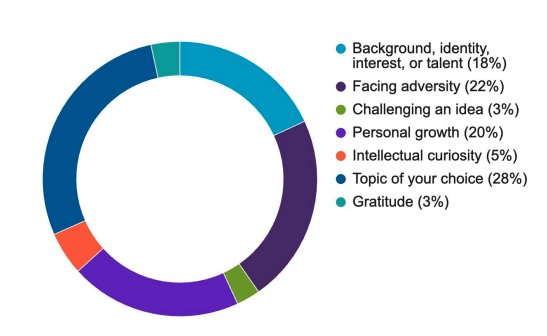
- Topic of Choice (Prompt #7) is the most popular (28%), but all prompts carry equal weight
- You have one personal essay to submit to all schools — choose the prompt that fits your story
The 2026-2027 Common App essay prompts are here, and the good news is that they’re unchanged. The Common Application officially announced the prompts on February 27, 2026, confirming that all seven prompts remain the same as the 2025-2026 cycle. No new changes, no new word limits, no structural shifts. This is the most stable prompt cycle in recent memory.
But stability cuts both ways. If the prompts haven’t changed, that means you have a wealth of existing resources to draw from — and it also means your essay carries even more weight. With colleges going test-optional and AI writing tools growing more capable, the personal essay is the only place where admissions officers can see authentic, original thinking that can’t be generated by a chatbot. That makes choosing the right prompt and writing a genuine essay more important than ever.
Let’s walk through every prompt step by step, including what they’re really asking, how to approach each one, and common mistakes to avoid. We’ll cover how to choose, how to start, and how to finish strong.
TL;DR: The Common App personal essay consists of seven prompts. Each one asks you to reflect on a personal experience or value. Your response should be between 250 and 650 words — aim for 550 to 650. The essay goes to every college you apply to through the Common App. All prompts are weighted equally. Choose the one that best fits your story.
Explore our writing services — if you need help brainstorming, drafting, or polishing your personal statement, our team of experienced academic writers is available 24/7.
The Common App Essay at a Glance
| Detail | What You Need to Know |
|---|---|
| Number of prompts | 7 |
| Word count | 250–650 words per essay |
| Essay count | One personal essay for all schools |
| Prompt selection | All prompts weighted equally |
| Most popular prompt | Topic of Choice (#7) at 28% |
| Second most popular | The Adversity Essay (#4) at 23% |
| Start timing | Summer before senior year |
Here’s the donut chart showing how students actually choose their prompts:
Source: Essay Coach
Now let’s break down each prompt.
Prompt 1: Background
Official prompt text:
Some students have a background, a story, or a core identity that they feel is so important that admissions officers simply must understand the rest of your application. If there’s a backstory you’d like to share, tell us about it.
What it’s really asking:
This prompt is asking: “Who are you when you’re not a student ID number?” It’s your chance to describe a background element — cultural, linguistic, socioeconomic, religious, geographic, or otherwise — that shapes how you see the world. The key word here is core identity. You’re not just describing where you grew up. You’re describing how that background has shaped your values, your goals, and your perspective.
How to approach it:
Think about an aspect of your life that most people would classify as a fixed condition — your family’s immigration story, your experience speaking a heritage language, your community’s economic reality. The best essays on this prompt connect the background directly to who you are now and who you want to become. Don’t just describe the background. Show how it influences your decisions, your passions, and your future.
Common mistakes:
- Writing a travelogue instead of a reflective essay. Your background is the subject, not the setting.
- Assuming all backgrounds are equal. This prompt works best when the background is genuinely central to your identity. If your background doesn’t meaningfully shape your worldview, another prompt may be a better fit.
- Trying to make poverty, cultural displacement, or hardship look impressive. Be honest. Admissions officers read thousands of essays — they can spot performative trauma.
Prompt 2: Overcoming a Challenge
Official prompt text:
The lessons we take from obstacles we encounter can succeed in the face of them is what defines a lot of people. Here, challenge, difficulty, or problem — no matter how personal or its nature — ask you to discuss the steps you took or what you did to find a solution to the challenge. It helps the committee understand your resilience and how you handle difficulties.
What it’s really asking:
Admittedly describes this as the most misunderstood prompt on the entire application 1. It’s not asking for a trauma dump. It’s asking for your response to a challenge — not the challenge itself. The key insight, which most students miss, is the 25/75 rule: effective challenge essays spend roughly 25% of the word count describing the obstacle and 75% on reflection and growth. The challenge is the setup; what you learned and how you changed is the payoff.
How to approach it:
Pick a challenge — big or small — that tested you and forced you to adapt. It doesn’t need to be world-shaking. A failing grade, a conflict with a teammate, a health setback, a mistake you made can all work. The critical move is to focus on what you did to deal with it and what you learned. Show your thought process. Show how the experience changed your approach to future obstacles.
Common mistakes:
- Spending the entire essay describing the challenge without reflecting on it. This is the single biggest error. If 80% of your essay is “here’s what happened to me” and only 20% is “here’s how I handled it,” you’ve missed the point.
- Blaming others. Even if the challenge involved someone else’s behavior, focus on your response, not their fault.
- Making the challenge too small. A challenge essay should show genuine growth, even if the trigger event is modest.
Prompt 3: Problem-Solving and Personal Growth
Official prompt text:
Every person has a unique personal story. What’s yours? Describe a place or a person — your community, a family member, a teacher, a mentor, or a place you’ve been — who has shaped who you are. Tell us about the lessons you’ve learned, the goals you’ve achieved, and the person you’ve become.
What it’s really asking:
This prompt is asking about influence. Who or what has shaped you? It’s about the people, places, or ideas that have made you who you are. The trick is that this isn’t about the person or place themselves — it’s about how they’ve shaped you. The essay should center on your growth, not the subject’s achievements.
How to approach it:
Choose someone or something genuinely influential in your life. It could be a grandparent, a coach, a friend, a book, a faith community, or even a place like your hometown. Focus on how they’ve influenced your thinking, your values, or your direction. Show specific moments or patterns where their influence shows up in your life. End with how that influence continues to shape your future plans.
Common mistakes:
- Writing a tribute essay about someone else. This is about YOU. The person or place is the lens, not the subject.
- Being too vague. Instead of “my grandmother influenced me,” show a specific moment or pattern. What did she do? What did you learn? How does it show up now?
- Picking someone famous or overly dramatic. The best essays often involve ordinary people doing extraordinary things in the context of your life.
Prompt 4: Gratitude and Meaning
Official prompt text:
Reflect on a time when you were thankful for a new or different perspective. Describe the situation, how you felt, and why the perspective mattered to you. What did you learn, and how did it change you?
What it’s really asking:
Jengo describes this as “not a thank-you note but an X-ray of your values” 1. This prompt is asking: When have you truly seen the world through someone else’s eyes? It’s about a moment of perspective shift — something that made you grateful for a different viewpoint. The emotional intelligence in this essay can reveal maturity, empathy, and the ability to learn from unexpected sources.
How to approach it:
Think about a time when something changed your mind, expanded your understanding, or gave you a perspective you wouldn’t have had otherwise. It could be an experience (a trip, volunteering, a conversation), an idea (a book, a lecture, a debate), or a relationship (someone who showed you something you didn’t see before). The essay should highlight: the situation, how you felt, why the perspective mattered, and how it changed you.
Common mistakes:
- Writing a generic thank-you letter. This isn’t about gratitude for a gift or help. It’s about gratitude for a perspective.
- Focusing only on the moment without the transformation. Show how the new perspective affected your future decisions, your relationships, or your worldview.
- Picking a safe, inoffensive story. The best essays on this prompt involve real discomfort, real learning, real change.
Prompt 5: Accomplishment or Growth
Official prompt text:
Think about an accomplishment, event, or realization that sparked a period of personal growth or a new understanding of yourself or others. Describe the accomplishment, the moment of growth, and how it affected you. What did you learn? How did it change you?
What it’s really asking:
This prompt is asking for a transformation story. An event, accomplishment, or realization led to personal growth. Tell us about that transformation. Unlike Prompt #4 (which is about gaining perspective), this one is about your own development — a moment or process that made you grow.
How to approach it:
This is your chance to describe a moment of clarity, a breakthrough, or a period of genuine growth. It could be an academic accomplishment, a personal achievement, a moment of self-awareness, or a realization that shifted your direction. The emphasis should be on the growth itself — not just the accomplishment. What did you discover about yourself? How did it change your goals or your approach to life?
Common mistakes:
- Listing accomplishments without reflecting on the growth. Don’t just describe what you achieved. Describe what it taught you.
- Making the growth seem effortless. Growth is usually messy. Show the process, not just the outcome.
- Overstating the significance. Not every growth moment needs to be earth-shaking. Honest reflection on a modest but genuine shift works better than claiming world-altering transformation.
Prompt 6: Why This Major?
Official prompt text:
What would you say is the reason why are you applying for this major or minor at your chosen university? What aspects of that major or minor interest you and inspire you?
What it’s really asking:
Collegewise notes this is about intellectual curiosity 1. They want to see genuine passion for your academic interests. The key is to show not just what you want to study, but why — and the “why” should be specific, personal, and rooted in your experiences. This is your chance to demonstrate the kind of thinking that makes you interesting to have in a classroom.
How to approach it:
Connect your academic interest to real experiences. Did a childhood hobby spark a fascination? A classroom experience change your understanding? A real-world problem that draws you in? Show the evolution of your interest — how it developed, what you’ve done to explore it, and what you want to do next. Be specific about what aspect of the field excites you.
Common mistakes:
- Naming a major without explaining the “why.” Don’t just say “I want to study biology because I like science.” Be specific.
- Listing extracurricular activities without connecting them to intellectual curiosity. The activities matter, but the essay should focus on your thinking, not just your resume.
- Being generic about the field. Show what specifically excites you about your chosen area. Is it the research process, the practical applications, the theoretical framework?
Prompt 7: Topic of Your Choice
Official prompt text:
You may submit essays on topics of your own choice. They may respond to the above prompts, or they may be on any topic of your choice. It may be one long answer to a single question or a series of short answers on different topics — all in response to the same question or on different topics.
What it’s really asking:
This is the open-ended option. Topic of Choice accounts for 28% of all prompt selections — making it the single most popular choice. Students often dismiss it as the “lazy” option, but admissions officers score the essay, not the prompt. The freedom of Prompt #7 is a strategic advantage if you have a story that doesn’t fit the other six. It’s also where creative formats can shine.
How to approach it:
This prompt works best when you have a unique story or perspective that doesn’t fit the other prompts. It could be a creative narrative, a series of short responses, an experimental format, or a deep dive into a personal passion. The freedom is a responsibility — you need to structure your essay carefully so it doesn’t read as aimless.
Common mistakes:
- Choosing this prompt because it’s “easy.” The prompt itself is the easiest. The essay still needs to be thoughtful, reflective, and well-structured.
- Being too experimental. Creative formats work, but they need to serve the story. If the format doesn’t add value, stick to a traditional structure.
- Picking this prompt when another fits better. If your story is clearly about a background, a challenge, a moment of growth, or a major interest — use the specific prompt. The targeted prompts are often stronger because they provide a built-in structure.
How to Choose Your Prompt
Here’s the uncomfortable truth: most students pick a prompt before they know their story. They read the prompts and decide which one sounds best for them. Don’t do that.
Sara Harberson’s research on college essays reveals a much better approach: build a “Me List” first 1.
The Me List Method:
- Write down 10-20 defining experiences, values, or perspectives from your life
- Read over your list and highlight the ones that feel genuinely important
- Match the strongest stories to the prompts that fit them best
- Let the story lead, not the prompt
Students who spend equal time brainstorming topics as they spend writing drafts produce the strongest essays. Don’t rush into writing before you’ve found your story.
Prompt selection statistics from the 2025-2026 cycle:
| Prompt | Percentage | Notes |
|---|---|---|
| #7: Topic of Choice | 28% | Most popular, but often misunderstood |
| #4: Gratitude & Perspective | 23% | Second most popular; “sleeper” prompt |
| #1: Background | 15% | Strong for students with formative identities |
| #2: Challenge | 13% | Clear narrative structure; 25/75 rule applies |
| #5: Growth | 12% | Great for transformation stories |
| #3: Influence | 8% | Underused; often the best fit |
| #6: Major Interest | 5% | Least popular but most specific |
All prompts carry equal weight. Admissions officers don’t rank prompts. They score the essay. The right prompt is the one where your story shines.
Get expert help with your personal essay — Our team of experienced writers can help you brainstorm, draft, and refine your Common App essay to make it authentic and compelling.
How to Start: Opening Lines That Admissions Officers Remember
The first sentence of your Common App essay is the hardest sentence you’ll write. It’s also the most important. Here are three hook styles from Ryan Kelly and Rob Humbracht’s analysis at Passport Admissions 1 that make personal statements stand out:
1. The Counterintuitive Hook
Start with something that surprises the reader — a statement that seems contradictory or unexpected, then reveal why it’s true. Example: “I’ve always been terrible at cooking. My pancakes look like charcoal, my scrambled eggs are rubber, and my only successful dish requires a microwave. But I made it anyway.”
2. The Contrarian Hook
Challenge a common assumption. Instead of “hard work leads to success,” try “I’ve learned that hard work doesn’t always lead to success — and that’s okay.” This creates cognitive tension that pulls the reader forward.
3. The Morally Ambiguous Hook
Start with a moment where you weren’t the hero. Admissions officers read thousands of essays about people who were always right, always kind, always brave. Starting with a moment of real moral complexity — a time you were confused, conflicted, or wrong — creates immediate authenticity.
Harvard Summer School adds another useful concept: the “kick” 1. Your opening line should kick the reader into the story. Don’t warm up. Don’t give background. Start with the moment, the question, or the observation that matters most.
Here’s what the opening line should do:
- Create curiosity (make the reader want to keep reading)
- Establish voice (show you, not just describe you)
- Hint at the essay’s theme (give a subtle signal about what’s coming)
Let us help you craft a memorable opening — Our writers specialize in creating openings that make admissions officers sit up and read.
Word Count Reality
Here’s a hard truth: writing exactly 250 words produces an underwhelming essay. The 250-word minimum exists, but hitting it is almost always a mistake.
Jengo recommends aiming for 550-650 words 1. Most students should target 500 as a practical minimum. Essays that land in the 550-650 range tend to feel complete, reflective, and substantial — not rushed or padded.
The reason is simple. The word count isn’t a constraint; it’s a suggestion of the minimum effort expected. An admissions officer reading dozens of essays per day expects substance. A 250-word essay will feel like you couldn’t find enough to say. A 600-word essay says: “I thought about this deeply.”
How to manage word count:
- Draft freely. Write as much as you have to say.
- Cut ruthlessly. Remove tangents, repetitive points, and unnecessary background.
- Aim for 550-650. If you’re at 500 and the essay feels complete, that’s okay. If you’re at 300, you’ve probably stopped too early.
Timing: When to Start Your Essay
The advice is consistent across every source we reviewed: start in the summer before senior year.
Harvard Summer School, Collegewise, and Jengo all recommend this timeline. Here’s why:
- You need time to brainstorm using the Me List method (which takes real effort)
- You need time for multiple drafts and revisions
- You need time to step away and come back with fresh eyes
- Starting in August gives you four months before application deadlines (November-December)
Don’t wait until October. Don’t wait until September. Start in the summer. Even if you’re a junior — start then. The essay is the one piece of the application you control entirely, and it deserves the best possible attention.
Next Steps: What to Do Now
Here’s your action plan:
- Build your Me List — Write down 10-20 defining experiences. Don’t filter. Just write.
- Read the prompts — After your Me List, match your strongest stories to the prompts.
- Draft freely — Write 550-650 words. Don’t worry about perfection yet.
- Revise ruthlessly — Cut tangents. Sharpen your voice. Make every sentence earn its place.
- Get feedback — Share with a teacher, counselor, or trusted adult.
- Submit it — Your essay goes to every school you apply to through the Common App.
Your personal essay is the one part of your application where you have total control. It’s your chance to speak directly to admissions officers. The prompts are the same this year. The strategy is the same. What matters is your voice — authentic, thoughtful, and unmistakably yours.
Order your Common App essay today — Our writers can help you from brainstorming through final polish. We guarantee original content written from scratch, with unlimited revisions until you’re satisfied.
Related Guides
- UCAS Personal Statement 2027: 3-Question Format with Examples — If you’re also applying to UK universities, here’s how the UCAS personal statement works and what it requires.
- Scholarship Essay Examples: 10 Winning Templates by Category — Scholarship essays have different requirements. These templates cover the most common scholarship essay categories.
- Study Abroad Personal Statement: 2026 SOP Examples and Winning Structures — If you’re applying for study abroad programs, here are structures and examples that work.
Final Thoughts
The 2026-2027 Common App essay prompts offer seven paths to the same destination: showing admissions officers who you are. No matter which prompt you choose, the principles are the same. Be authentic. Be reflective. Be specific. Your essay should read like you — not a template, not a machine, not a polished corporate statement.
Admissions officers are human. They’re reading thousands of essays. They remember the ones that feel real, the ones that show genuine thought, the ones that make them sit back and think: “This is a person I’d want in my classroom.”
Start early. Start honestly. And don’t let perfectionism stop you from submitting something that’s genuine and well-written. Your Common App essay doesn’t need to be flawless. It needs to be you.
Sources & References
The information in this guide is based on research from the following authoritative sources:
- Official Common App — Announcing 2026-2027 Common App Essay Prompts
- Ethan Sawyer (College Essay Guy) — Common App Essay Prompts
- Admittedly — Common App Essay Prompts 2026-2027
- Julia Byrd (Essay Coach) — Common App Changes 2026-27
- Collegewise — Tackling the Common App Personal Essay
- Sara Harberson — Secret Tip for Writing an Unforgettable College Essay
- Ryan Kelly & Rob Humbracht (Passport Admissions) — 3 Qualities of Great Personal Statement Hooks
- Harvard Summer School — 12 Strategies to Writing the Perfect College Essay
- Green Academics — 2026-2027 Common App Essay Prompts Guide
- Jengo — Common App Essays