
How to Write an IB Extended Essay: 2026 Guide


Key Takeaways
- The IB Extended Essay is a 4,000-word independent research paper — one of three core components of the IB Diploma (alongside TOK and CAS)
- Students in 2026 are the last cohort assessed under the old 34-mark system — the 2027 EE rebuilds everything with a 30-mark system
- Critical Thinking (Criterion C) is the make-or-break criterion — worth 12 marks (~34% of your total score)
- RPPF = 6 free marks for honest reflection — write it from day one, not the last week
- The #1 examiner mistake: submitting a topic title instead of a research question
What Is the IB Extended Essay?
Let’s cut to the chase: the IB Extended Essay (EE) is a 4,000-word independent research paper that every IB Diploma Programme student completes across 12 to 18 months. It’s one of the three core components of the IB Diploma — alongside Theory of Knowledge (TOK) and Creativity, Activity, Service (CAS).
Think of it as your first real taste of university-level research. You pick a subject, choose a research question, and spend months exploring it with the guidance of a supervisor. It’s not a classroom essay with assigned readings — it’s your own project.
Why It Matters
Here’s the part most students don’t fully understand: the EE isn’t just another assignment. It’s a make-or-break component of your entire IB Diploma.
- Grade distribution: Roughly 26% of students achieve an A, 39% a B, 24% a C, and 11% a D or E. That A-B boundary matters. (LeadingTuition)
- Bonus points: An A in the EE plus an A in TOK earns you 3 bonus points toward your IB Diploma. A B in the EE plus an A in TOK earns 2 bonus points.
- Failing condition: A grade E is a “failing condition” — you won’t receive your IB Diploma if you fail the EE, regardless of your subject scores.
That’s why taking this seriously from the start (not the last month) is so critical.
Official IB definition: The EE is “a prime opportunity for you to investigate a topic of special interest to you, which in turn can complement your interests across your other subjects.” (IB Official)
The 2027 EE Overhaul (Why 2026 Matters)
This is the part that gives your article its unique angle: students writing their EE in 2026 are the last cohort under the old 34-mark system.
For the first time, students in their final year (May 2027) will face a fundamentally rebuilt EE. Here’s what’s changing, and why the contrast matters for you.
The 34-Mark System (Old Rules — 2026 and Before)
| Criterion | Marks | What It Assesses |
|---|---|---|
| A: Focus and Method | 6 | Research question clarity, methodology appropriateness, structure |
| B: Knowledge and Understanding | 6 | Subject-specific knowledge, terminology, conceptual frameworks |
| C: Critical Thinking | 12 | Analysis, argument, evaluation quality |
| D: Presentation | 4 | Academic format, word count, bibliography, layout |
| E: Engagement | 6 | RPPF quality, intellectual growth, supervisor meetings |
| Total | 34 |
The 30-Mark System (New Rules — 2027 and After)
| Criterion | Marks | Weight | Focus |
|---|---|---|---|
| A: Framework | 6 | 20% | RQ and methodology |
| B: Knowledge | 6 | 20% | Subject-specific terminology |
| C: Analysis | 6 | 20% | Argument logic |
| D: Discussion | 8 | 27% | Evaluation (highest weighted) |
| E: Reflection | 4 | 13% | RPF statement (500 words) |
| Total | 30 |
What Changed
- Total marks: 34 → 30
- Criterion D is now the highest-weighted criterion at 8 marks (~27%)
- Reflection: The old format required 3 separate RRS (Reflection on Planning and Progress) entries. The new format collapses this into one consolidated RPF (Reflection and Progress Form) — up to 500 words, written after the viva voce
- World Studies: Replaced by a flexible Interdisciplinary Pathway (no “global significance” requirement)
- The 4,000-word limit stays the same
These changes have been confirmed across multiple authoritative sources including the IB’s own documentation and subject-specific briefs. (Bespoke Learning)
The “Last Cohort” Advantage
You’re writing under the old rules. That means:
- The familiar 34-mark system is still in play
- The 3 separate RRS entries are still required
- World Studies is still an available option (if you’re eligible)
But the 2027 changes also mean you have more time to plan — use the extended timeline to do thorough research before committing. The contrast between old and new systems is also useful context: you can compare both frameworks as you prepare.
The 4-Month Timeline (Phase-by-Phase)
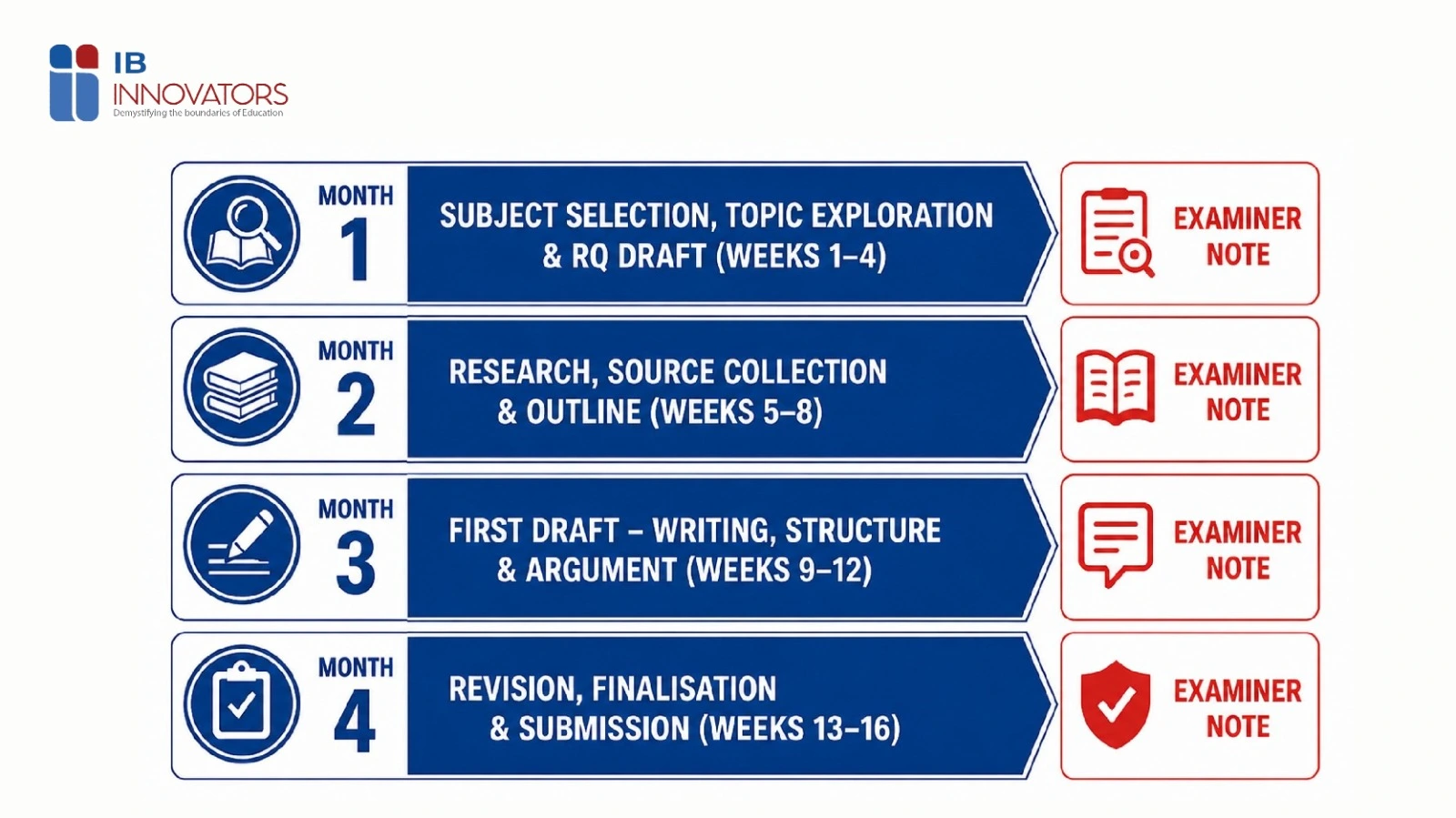
The EE typically takes 12 to 18 months from DP1 to DP2. Here’s a realistic 16-week plan that breaks the process into manageable phases.
Source: IB Innovators
Phase 1: Weeks 1–2 — Subject + Topic Selection
- Explore subjects you’re genuinely interested in
- Have initial conversations with your supervisor
- Start narrowing down to a specific area
Phase 2: Weeks 3–4 — Research Question + Approval
- Draft your research question
- Get supervisor approval
- Lock in your RQ (changing it later is possible but painful)
- Complete your first RRS entry
Phase 3: Weeks 5–7 — Full Research
- Conduct general searches plus Google Scholar
- Collect primary and secondary sources
- Start organizing your reading notes
Phase 4: Weeks 8–9 — Structure + Outline
- Create an outline with thesis and section plan
- Define your analytical approach
- Make sure your methodology matches your subject
Phase 5: Weeks 10–13 — Writing
- Write body sections first (easier than starting with the introduction)
- Draft introduction and conclusion last
- Don’t worry about perfection yet — focus on getting ideas down
Phase 6: Weeks 14–16 — Revision + RPPF + Submission
- Polish structure and argument
- Complete the RPPF reflections
- Run a final submission checklist (see section below)
- Have your viva voce interview
- Submit
Traditional Timeline (12–18 Month)
- February–April (DP1): Subject exploration, first RQ drafts, initial source reading
- May–June (DP1): First mandatory reflection session. Finalise subject and RQ.
- July–September (Summer): Research phase. Collect primary/secondary sources. Draft introduction and first body section.
- September–November (DP2): Second reflection session. Submit first draft.
- December–January (DP2): Supervisor feedback. Revisions. Third RRS entry.
- February–March (DP2): Polish. Final structure check. Viva voce. Submit.
Choosing Your Topic and Research Question
Your research question (RQ) is the single most important determinant of your EE’s success. Getting it right means the rest of the process flows. Getting it wrong means you’ll struggle the entire way.
The Funnel Method
The best topic selection follows a funnel — start broad and narrow down:
- Start broad: Biology
- Get specific: Human health
- Make it researchable: “The effect of caffeine on heart rate in teenagers”
This keeps your topic manageable and focused enough for 4,000 words. (Save My Exams)
What Makes a Strong Research Question
- Specific: Narrow enough to address in 4,000 words (time period, place, population, phenomenon bounded)
- Arguable: Requires analysis and evaluation, not just a factual response
- Researchable: Uses sources or data you can actually access
- Evaluative framing: “To what extent,” “How far,” “In what ways” — not “What is,” “Did,” “Was”
Strong vs Weak Research Questions
| Subject | Weak RQ | Strong RQ |
|---|---|---|
| Economics | “How does inflation affect growth?” | “To what extent did the ECB’s 2015–2018 QE programme achieve its inflation targets in Germany and France?” |
| History | “Did World War Two have economic consequences?” | “To what extent did the Lend-Lease Act (1941–45) determine the post-war economic recovery of the UK?” |
| Biology | “How does exercise affect the body?” | “To what extent does 30-minute HIIT affect resting heart rate in 16–18 year-old males over 8 weeks?” |
The Topic vs Question Trap
Here’s the single most common mistake examiners see: submitting a topic title instead of a research question.
- Topic (weak): “Effects of Climate Change” — this is a subject, not a question
- Research question (strong): “To what extent has sea-level rise threatened agricultural viability in Kiribati between 2000 and 2020?” — this is specific, arguable, and researchable
Submitting a topic instead of a question limits your Criterion A marks from the very first paragraph.
Subject-Specific Methodology Differences
Not all EEs are created equal. Your subject dictates the format, structure, and what examiners expect. Following your subject’s conventions is non-negotiable — it affects both Criterion B and D. (These requirements are documented in IB subject briefs and examiner guides.) (IB Innovators)
Sciences (Group 4): Biology, Chemistry, Physics, ESS
- Expected to involve primary experimental data
- Must maintain a strict scientific angle (not social or medical commentary)
- Structure: Formal scientific paper — methodology, raw/processed data, results, analysis, discussion
- Citations: APA or Harvard
- Must address precision, errors, and methodology limitations
- Must adhere to IB safety and animal experimentation guidelines
What to avoid: Writing a social commentary about climate change when the EE expects a lab-method report.
Individuals & Societies (Group 3): Economics, Business Management, Psychology, Geography
- Combine primary or secondary data with theoretical frameworks
- Analysis relies on comparing perspectives, interpreting data, weighing counterclaims
- Structure: Thesis-driven argumentative essay with thematic sections
- Referencing: Chicago footnotes for History; APA or Harvard for Economics, Psychology
What to avoid: Failing to engage with competing interpretations of your data.
Language & Literature / Language Acquisition (Groups 1 & 2)
- Group 1 (Language & Literature): Literary analysis of specific texts, authors, or techniques
- Group 2 (Language Acquisition): Comparative linguistic analysis using frameworks (discourse analysis, pragmatics, systemic functional linguistics)
- Must not be biographical or historical — must apply literary/linguistic frameworks
Mathematics (Group 5)
- Requires genuine mathematical exploration — not a survey of existing knowledge
- Math AA: Abstract/analytical reasoning, proofs, convergence, algebraic extensions
- Math AI: Applied mathematical modelling, statistics, optimisation, real-world phenomena
What examiners look for: Original mathematical reasoning, not just collecting results from textbooks.
Arts (Group 6)
- Investigate specific works, practitioners, or movements through an analytical lens
- Not descriptive — must apply analytical frameworks
The Five Assessment Criteria
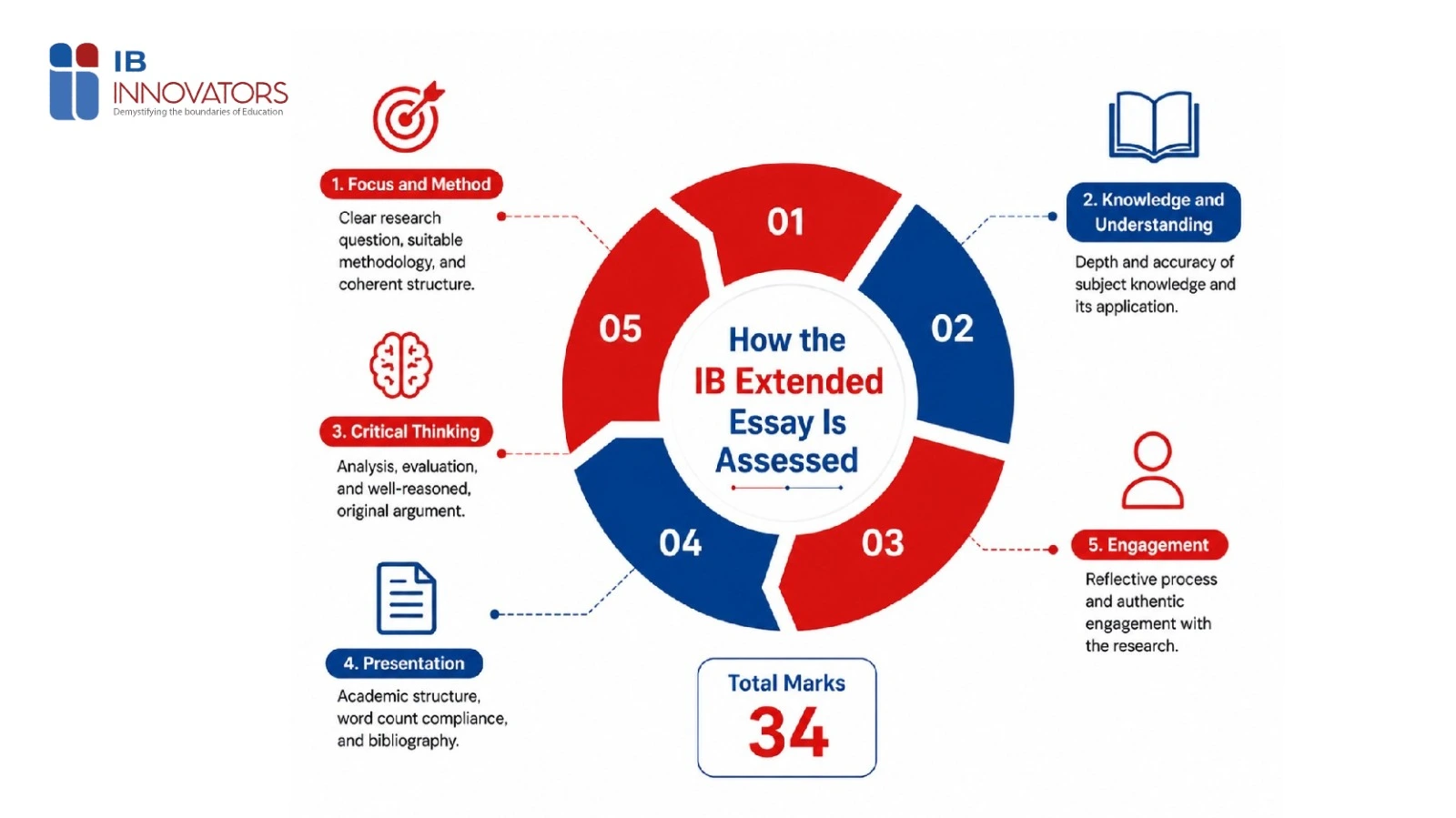
Under the old 34-mark system (still in place for 2026 students), your EE is graded across five criteria. Here’s what each one actually assesses — and what examiners look for.
Source: IB Innovators
Criterion A: Focus and Method (6 marks)
- What it assesses: Research question clarity, methodology appropriateness, structural coherence
- What examiners look for: A specific, arguable, researchable RQ within 4,000 words. Clear methodology that matches your subject.
Criterion B: Knowledge and Understanding (6 marks)
- What it assesses: Subject-specific knowledge, terminology, conceptual frameworks
- What examiners look for: Demonstrates understanding of the academic conversation — not just summarising facts. You should show you’ve read beyond basic textbook material.
Criterion C: Critical Thinking (12 marks) — The Make-or-Break Criterion
This is the single highest-weighted criterion — 12 marks out of 34, roughly 34% of your total score. Most students lose marks here by describing rather than analysing.
- What it assesses: Analysis, argument, evaluation quality
- What examiners reward: Sustained original reasoning. They want to see you engage with evidence and draw your own conclusions.
- What they punish: Description that reads like a textbook summary. Paragraphs that explain “what X is” rather than “what this evidence suggests.”
- The fix: After every factual statement, ask: “So what does this evidence actually prove?” Then answer that question.
Criterion D: Presentation (4 marks)
- What it assesses: Academic format, word count, bibliography, layout
- What examiners look for: Consistent citation style, complete bibliography, correct formatting per subject conventions
- Free points: If done correctly, these 4 marks are basically free. Inconsistent citations = mark loss.
Criterion E: Engagement (6 marks)
- What it assesses: RPPF quality, intellectual growth, supervisor meetings
- What examiners reward: Genuine reflection at each stage, not retrospective form-filling
- What they can detect: Students who write reflections retrospectively in 48 hours. Examiners read thousands of EEs and spot generic entries immediately.
Common Mistakes That Cost Grades
Examiners see the same errors repeatedly. The following 10 examiner-penalty mistakes — sourced from certified IB examiners at PrepSeven and IB Innovators guides — show what actually costs marks, with concrete fixes for each.
Note: IB Innovators also provides a visual guide illustrating these common mistakes. (Image source provided for reference.)
Source: IB Innovators
1. Topic vs Question Confusion (Criterion A)
Mistake: Submitting a topic title instead of a research question.
Fix: Make sure your RQ is specific, arguable, and researchable. Use evaluative framing (“To what extent,” “How far”).
2. Descriptive Writing Instead of Analysis (Criterion C)
Mistake: Paragraphs that “explain what X is” rather than “what this evidence suggests.”
Fix: After every factual statement, ask “So what does this actually prove?” Then answer.
Example:
- Descriptive: “Bread prices rose in 1788.”
- Analytical: “While bread price inflation is often cited as the primary trigger, contemporary wage records suggest stagnant wages since 1785 — implying price shocks acted as catalysts for pre-existing grievances, not root cause.”
3. Neglecting Counterarguments (Criterion C)
Mistake: Writing as an uninterrupted case for your thesis without engaging alternatives.
Fix: Actively seek the strongest counter-evidence and explain why your argument still holds. Examiners read this as lack of critical distance.
4. RPPF Written Retrospectively (Criterion E)
Mistake: Writing reflections in the final 48 hours before submission.
What scores poorly (2–3/6): Generic summaries like “I learned a lot about time management.”
What scores highly (5–6/6): “After my first round of interviews returned inconclusive results, I revised my sampling method to include…”
Fix: Use the 5-line reflection template (from RevisionDojo):
- What changed?
- Why did it change?
- What did you learn about your question/method?
- What’s the next step?
- What still feels uncertain?
5. Word Count Exceeded (Criterion D)
Mistake: Exceeding the 4,000-word limit.
Rule: IB examiners are instructed to stop reading at 4,000 words. Anything beyond that earns zero marks.
What counts: Introduction, body paragraphs, conclusion, in-text citations.
What doesn’t count: Title page, table of contents, abstract, bibliography, footnotes/endnotes used solely for citations, appendices.
A-grade typical range: 3,800–4,000 words effectively.
6. Citation Chaos (Criterion D)
Mistake: Switching citation styles mid-essay, missing bibliography entries.
Fix: Pick ONE citation style (MLA, APA, Chicago) before writing. Keep a source log from day one.
7. Padding with Unnecessary Background (Criterion C)
Mistake: General context paragraphs that don’t serve the argument.
Test: “Could this paragraph be deleted without weakening my argument?” If yes — cut it.
Impact: Pages spent on context are pages NOT spent on analysis.
8. Choosing a Topic With No Data Access (Criterion A, B)
Mistake: History EE depending on untranslated primary sources. Psychology EE requiring experiments on vulnerable populations.
Fix: Check feasibility BEFORE committing — not after weeks of frustrated research.
9. Ignoring Subject-Specific Conventions (Criterion B)
Mistake: Science EE without a methodology section. History EE not engaging with historiography. English EE not closely analysing actual passages.
Fix: Read your specific subject’s EE guide (available through your supervisor).
10. Academic Honesty / Unintentional Plagiarism
Mistake: Sloppy note-taking where paraphrase drifts close to original wording.
Consequences: Mark of zero for the essay. Entire Diploma at risk in serious cases.
Fix: Keep a running research log from your first source. Note page numbers and exact quotations.
Word Count Rules and Presentation Checklist
Word count isn’t just a number — it’s a hard boundary that examiners enforce mechanically.
Word Count Rules
- Maximum: 4,000 words (strict)
- What counts toward the limit: Introduction, body paragraphs, conclusion, in-text citations
- What doesn’t count: Title page, table of contents, abstract, bibliography, footnotes/endnotes used solely for citations, appendices
- Consequence of exceeding: Examiners stop reading at 4,000 words. Everything beyond is ignored.
Presentation Checklist (Criterion D)
- Title page with: title, research question, subject, word count
- Consistent citation style throughout (MLA, APA, or Chicago)
- Complete bibliography matching in-text citations
- Correct formatting per subject conventions (methodology section for Sciences, thesis structure for Humanities)
- Table of contents and page numbers
- Clear tables and figures with labels
- Word count verified against official IB rules
The RPPF / RRS: Your Secret Weapon for Easy Marks
Criterion E (Engagement) is worth 6 marks — and it’s the easiest criterion to mess up or nail, depending on how you approach it.
What Is the RPPF?
The RPPF (Reflection on Planning and Progress Form) replaced older RRS entries. For 2026 students, you complete three separate Reflection entries across your EE process. (In 2027, this collapses into one 500-word RPF statement.)
What Examiners Look For
Full marks (5–6/6): Genuine intellectual curiosity, specific decision points, problems encountered, evolution of your thinking.
Poor marks (2–3/6): Generic summaries (“I learned a lot”), written retrospectively in 48 hours, no specific details.
The Key Insight
Many students write their reflections in the final 48 hours before submission, scoring 2–3/6. Students who reflect genuinely throughout earn 5–6/6 with minimal extra effort. Examiners can detect retrospective entries — they read thousands of EEs and spot the generic pattern immediately.
What we recommend: Start your RPPF on day one. After every supervisor meeting, jot down what you discussed, what you learned, and what you’re changing. Five minutes per meeting is all it takes. That’s 6 free marks that cost almost no extra effort.
How to Get Help with Your IB Extended Essay
Writing a high-quality EE is one of the most challenging components of the IB Diploma. Between the research, writing, and reflection requirements, it’s easy to feel overwhelmed — especially if you’re juggling other subjects, exams, and CAS requirements.
That’s where professional support can help.
How Our Writers Can Help
At Essays-Panda, we have over 500 experienced academic writers covering virtually all IB subjects. Our IB specialists understand the specific requirements for each discipline — whether you’re writing a science EE with lab methodology, a history EE engaging with historiography, or a mathematics EE requiring genuine exploration.
- Custom writing: Our writers produce original, properly cited EEs tailored to your subject and research question
- Direct communication: Message your writer directly throughout the process to stay involved
- Originality guarantee: Every paper is written from scratch with zero plagiarism
- Transparent pricing: See the exact cost instantly — no hidden fees
Check our pricing to see tiered options, read about our team of 500+ writers (including IB specialists), or visit our services page for a full overview.
Still Have Questions?
Our FAQ covers common questions about our process, turnaround times, and revision policies. Or reach out directly through our contact form — our support team is available 24/7.
Ready to get started? Use our order form to place your EE writing request and speak directly with a writer.
This guide covers the essentials of writing a competitive IB Extended Essay under the current 34-mark system. Students in 2026 are writing under the old rules — make the most of them. Read our blog for more IB writing tips and academic guidance.
Explore more IB resources on our blog, or get started with your EE today.