
How to Write a Reflective Essay: Gibbs’ Reflective Cycle for Nursing, Education & Social Work Students


Key Takeaways
- A professional reflective essay is not a diary entry — it connects what happened in clinical or field work to theory, evidence, and actionable future behaviour
- Gibbs’ Reflective Cycle is the default model across nursing, education, and social work because it balances emotion (Feelings) with evidence (Analysis)
- The Analysis stage is where students lose marks — this is the section that separates a pass from a distinction, and it’s where you link experience to professional standards and theory
- Confidentiality isn’t optional — anonymise every patient, client, family, facility, and date; your professor is looking for this, and it’s a professional requirement
- Your action plan must be specific and measurable — “I will be more careful” is a trap; “I will verbalise the wristband-to-chart check aloud for every patient, even when busy” is what actually works
You’re on your first clinical placement, and your supervisor hands you a form that says “Write a reflective essay on a significant incident from your placement.” You open a blank document and start typing: “Today I helped a patient who was upset. I felt bad. I will do better next time.” You submit it, and you know you could have done more.
That’s exactly how the strongest students — and the weakest — begin. The difference between a B-grade reflection and an A-grade reflection isn’t the incident you choose. It’s how you structure your thinking about it.
A professional reflective essay takes a real experience from your placement, practicum, or field work, and turns it into structured professional development. You describe what happened, honestly examine how you felt, evaluate what worked and what didn’t, analyse the situation using theory and professional guidelines, draw conclusions about what you learned, and — most importantly — write a concrete action plan for how you will handle a similar situation differently next time.
The model your professors expect across nursing, education, and social work is Gibbs’ Reflective Cycle (Gibbs, 1988). It has six stages: Description, Feelings, Evaluation, Analysis, Conclusion, and Action Plan. Every professional reflective essay you’ll ever write fits into this structure.
Here’s what that looks like in practice:
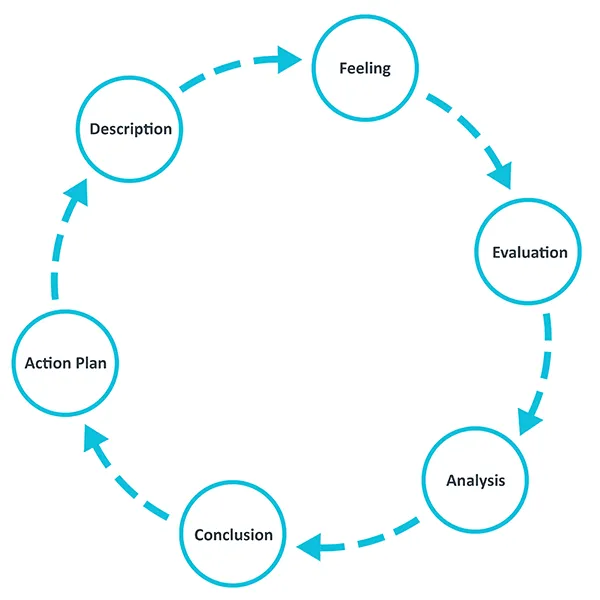
Source: University of Edinburgh Reflection Toolkit — Gibbs’ Reflective Cycle
What is a Reflective Essay (and How is it Different from Academic Reflection)?
Before you write a single sentence, you need to understand what type of reflective essay your professor is actually asking for. There are two fundamentally different kinds:
| Dimension | Academic Reflection | Professional Practice Reflection |
|---|---|---|
| Who it’s for | General college students writing coursework | Nursing, education, and social work students on placements, practicums, or field work |
| What you reflect on | Course experiences, readings, study strategies | Patient interactions, classroom incidents, client encounters, home visits |
| Purpose | Demonstrating understanding of course concepts | Professional development, competency evidence, regulatory compliance |
| What it links to | Theory from textbooks and lectures | Professional standards (NMC Code, social work ethics, teaching standards) + theory |
| Confidentiality | Minimal — you’re reflecting on your own learning | Mandatory — you’re reflecting on patients, clients, families, facilities |
| Tone | Academic but accessible | Professional, evidence-based, ethically grounded |
Your professor in a nursing program isn’t looking for an academic essay about reflective writing theory. They want you to reflect on something real — a medication error you caught, a difficult conversation with a distressed family, a lesson you taught that didn’t go as planned — and use that experience to demonstrate professional growth.
Nursing students write these for clinical placements, often aligned with the NMC Code and NMC revalidation requirements (UK registered nurses must submit 5 written reflections every 3 years for revalidation — each using a reflective model like Gibbs).
Education students (PGCE trainees) write them for practicum placements — reflecting on lessons taught, classroom incidents, and professional development.
Social work students write them for practice learning placements — reflecting on client engagement, home visits, critical incidents, and ethical dilemmas.
All three use Gibbs’ framework, all three require confidentiality, and all three expect analysis grounded in professional standards. That’s the common thread. The discipline-specific examples below will show you exactly what each looks like in practice.
Gibbs’ Reflective Cycle: 6 Stages Explained
Gibbs’ Reflective Cycle breaks reflection into six sequential stages. Each stage asks a different kind of question, and you must work through them in order. Skipping ahead to the Action Plan is the most common mistake students make — it produces shallow reflection that markers spot immediately.
Stage 1: Description — What Happened?
This is a factual account of what happened, with no judgement or analysis yet. You’re setting the scene for your reader.
Key questions: What happened? When and where did it happen? Who was involved? What did you and the other people do? What was the outcome?
Word count: 15–25% of your total essay.
What to include: Context (setting, people involved), sequence of events, your initial actions. Keep it neutral — no opinions, no feelings, no analysis.
What to avoid: Judgemental language (“The patient was being difficult”), emotional commentary, or analysis of why things went wrong.
Stage 2: Feelings — What Were You Thinking and Feeling?
Now you honestly examine your emotional response — before, during, and after the event. This is the stage where most students are uncomfortable, but it’s essential.
Key questions: What were you thinking and feeling before, during, and after? How did it affect you? What do you think others were feeling?
Word count: 10–15% of your total essay.
What to include: Genuine emotional reactions (anxiety, frustration, relief, embarrassment), physical responses (heart racing, feeling shaky), thoughts about how you were perceived by others.
What to avoid: Judging yourself harshly (“I was terrible”) or minimising (“I felt a little bit nervous”).
Stage 3: Evaluation — What Was Good and Bad?
Step back and make an honest assessment of what worked and what didn’t. Be fair to yourself — acknowledge what you did well and what you didn’t.
Key questions: What was good and bad about the experience? What worked well? What didn’t go so well? What did you and others contribute?
Word count: 10–15% of your total essay.
What to include: Specific positives and negatives from the situation, considering your own actions and the actions of others.
What to avoid: One-sided accounts (“Everything went wrong” or “Everything was perfect”).
Stage 4: Analysis — Why Did It Happen?
This is the heart of the reflection — the longest section, where you make sense of the situation using theory, evidence, and professional guidelines.
Key questions: Why did things go the way they did? What does the literature or guidance say? What knowledge helps me understand this?
Word count: 30–40% of your total essay. This is where students lose marks.
What to include: Links to professional standards, academic literature, evidence-based practice, relevant frameworks. Analyse contributing factors (time pressure, lack of knowledge, communication breakdown, emotional factors).
What to avoid: Restating the Description or Feelings stages. This section must add new insight through evidence and reasoning.
Stage 5: Conclusion — What Did You Learn?
Summarise your key learning and what you could have done differently. This is not the same as the essay conclusion — it’s the Gibbs Conclusion stage.
Key questions: What did you learn? What could you have done differently? What skills do you need to develop?
Word count: 10–15% of your total essay.
What to include: Generalisable lessons (not specific to one patient or incident), insights about your own practice, recognition of gaps in knowledge or skills.
What to avoid: Introducing new incidents or analysis. This is a summary of what you’ve already discussed.
Stage 6: Action Plan — What Will You Do Next Time?
Concrete steps for how you will handle a similar situation in the future. This turns reflection into professional development.
Key questions: If it happened again, what would you do differently? What will you change, and how will you prepare?
Word count: 10–15% of your total essay.
What to include: Specific, measurable, realistic steps. Link directly to the lessons from the Analysis and Conclusion stages.
What to avoid: Vague intentions (“I will be more careful”), “I will try harder,” or plans that don’t connect to your analysis.
How to Write Each Stage (With Discipline-Specific Examples)
Now let’s walk through each stage with discipline-specific examples. The nursing example below will show you the full cycle in action, followed by shorter examples for education and social work.
Stage 1: Description (Full Nursing Example)
“During my second-year placement on a surgical ward, I was administering a morning drug round under the supervision of my mentor. I prepared a dose of oral analgesia for a patient in Bed 7. Before giving it, my mentor noticed I had not checked the patient’s wristband against the chart and had relied on the bed number alone. No drug was given to the wrong patient, but the near miss was logged by the ward as a medication safety incident.”
Why this works: Pure facts — who, what, when, where, outcome. No feelings, no judgement, no analysis.
Stage 2: Feelings (Full Nursing Example)
“In the moment, I felt embarrassed and anxious, and I worried my mentor would think I was careless. After the incident was logged, I felt relieved that nothing reached the patient, but also unsettled — I had drifted into an unsafe habit so easily that I didn’t even notice it. I imagine my mentor felt a duty to intervene quickly, and I suspect the patient would have wanted to feel confident in their care.”
Why this works: Honest emotional response, physical sensations (implied anxiety), awareness of how others may have felt.
Stage 3: Evaluation (Full Nursing Example)
“What went well was that the error was caught before it reached the patient, and that I disclosed it openly rather than hiding it. What went badly was that I had skipped a core identification check because the ward was busy and I was rushing to finish the round on time. The patient safety risk was real even though it was prevented.”
Why this works: Balanced — acknowledges both positive (disclosure, caught by mentor) and negative (skipped check, time pressure). Doesn’t minimise the risk.
Stage 4: Analysis (Full Nursing Example)
“Looking at this against the NMC Code and the ‘rights’ of medication administration (right patient, right drug, right dose, right route, right time), my error was a failure of patient identification driven by time pressure. The literature on medication errors consistently links them to interruptions and high workload rather than lack of knowledge (Purden & Stoddart, 2021), which matches my experience — I knew the check was required but let workflow pressure override it. Benner’s theory of novice-to-expert progression (2001) suggests beginners rely heavily on rules and can be easily overwhelmed by competing demands; I definitely felt overwhelmed when the ward was busy and I tried to prioritise speed over safety.”
Why this works: Links experience to professional standards (NMC Code), academic literature (medication error research), and nursing theory (Benner). Explains why the error happened, not just what happened.
Stage 5: Conclusion (Full Nursing Example)
“I learned that procedural safety checks are most vulnerable exactly when I feel rushed, and that competence is not just knowing the rule but protecting the moment in which I apply it. I could have paused, completed the wristband check regardless of the clock, and accepted that finishing slightly late is preferable to an unsafe round. I also learned that I need to develop the self-awareness to recognise when workflow pressure is compromising safety.”
Why this works: Generalisable lessons (not specific to one patient), recognition of patterns (rushed = vulnerability), insight about competence beyond knowledge.
Stage 6: Action Plan (Full Nursing Example)
“In future, I will treat the wristband-to-chart check as a non-negotiable step that I verbalise out loud for every patient, even when busy. I will ask my mentor to observe my next three drug rounds specifically for identification, and I will review the ward’s medication safety policy before my next shift so the process becomes automatic. I will also discuss this incident in clinical supervision to get feedback on managing time pressure without compromising safety.”
Why this works: Specific, measurable, realistic steps. Each action connects directly to the Analysis stage. Includes mentor feedback and clinical supervision — professional development practices.
Discipline-Specific Examples: Education and Social Work
Here’s how Gibbs’ stages look for the other two audiences, using shorter examples you can adapt for your own writing.
Education Example: Reflecting on a Lesson That Didn’t Go as Planned
Description: “During my Year 9 English practicum, I taught a lesson on creative writing to a class of 28 students. I had planned a creative writing exercise where students would write a short story using dialogue techniques. I provided examples and models, and students worked in pairs. Halfway through the lesson, three students left the room without permission, and the remaining pair I had assigned to sit together argued throughout the activity. I spent more time managing behaviour than teaching content.”
Feelings: “I felt frustrated and anxious. I had prepared the lesson carefully, and I expected it to go smoothly. When students left the room, I felt like I was losing control. I was angry at the students but also worried I had planned something too ambitious for a class with established behaviour issues.”
Evaluation: “What worked was that the creative writing model I provided was clear and students who stayed engaged produced good work. What didn’t work was that I hadn’t anticipated the behaviour challenges, and I had planned too much content for a single lesson. My mentor noted later that I had been trying to cover too much rather than focusing on one or two learning objectives.”
Analysis: “According to classroom management research (Marzano et al., 2005), behaviour issues in secondary classrooms are often triggered by mismatched expectations and unclear routines, not student defiance alone. My lesson plan assumed students would self-regulate their pair work, but the literature shows that successful pair work requires explicit routines and monitoring. The Education, Skills and Research Association (ESRA) guidelines for practicum lessons emphasise that lesson planning should prioritise manageable scope over comprehensive coverage.”
Conclusion: “I learned that I need to plan for behaviour expectations explicitly, not assume they will emerge naturally. I also learned that covering less content more effectively is better than covering everything superficially.”
Action Plan: “For my next lesson, I will build in explicit pair-work routines at the start, set a clear time limit for the activity, and check understanding every 10 minutes instead of waiting until the end. I will also consult my mentor about behaviour management strategies specific to Year 9.”
Social Work Example: Reflecting on a Home Visit
Description: “I attended a home visit with my supervisor to a family involved in a child protection case. The mother was defensive when we arrived, and the children were hiding in another room. My supervisor led the conversation while I took notes. The mother interrupted frequently and accused us of ‘judging’ her parenting. We left without achieving the agreed objectives.”
Feelings: “I felt nervous and uncertain about my role. I wasn’t sure when I should speak and when I should stay silent. I also felt frustrated because I could see the supervisor struggling to connect with the mother, and I didn’t know how to help. I wondered if I had the right skills for this kind of work.”
Evaluation: “What worked was that my supervisor maintained a professional, non-confrontational tone throughout. What didn’t work was that we didn’t achieve the meeting objectives, and the mother felt defensive rather than engaged. I also realised I wasn’t contributing meaningfully to the interaction.”
Analysis: “Social work literature on home visits emphasises that families in child protection contexts often feel stigmatised and fear judgment (Bowlby & Howe, 2021). The mother’s defensiveness was likely a response to perceived threat, not deliberate opposition. BPSW (British Association for Social Work) practice guidance recommends building rapport before addressing concerns. My failure to anticipate this dynamic suggests I was approaching the visit with a task-focused mindset rather than a relationship-focused one. My supervisor had anticipated the defensiveness and built time for rapport before the substantive discussion — I hadn’t recognised this strategy at the time.”
Conclusion: “I learned that approaching families in child protection cases requires patience and rapport-building before any task-focused discussion. I also learned that I need to develop the skill of reading family dynamics in real time rather than focusing on my notes.”
Action Plan: “I will read the BPSW guidance on home visits before my next placement. I will ask my supervisor to debrief with me after each home visit to discuss family dynamics. I will practice active listening techniques through role-play exercises before the next visit.”
The Analysis Stage: Where Students Lose Marks
Let’s address the single most important section of this article: the Analysis stage is where students lose marks.
Every source I examined — UK Essays, Assignment Cart, ResearchProspect, the Edinburgh Reflection Toolkit, and social work training materials — explicitly states that students under-develop the Analysis stage. It’s the most common reason for a B or C grade when everything else is done well.
Here’s why:
| What Students Write Instead | What You Should Write Instead | Why It Matters |
|---|---|---|
| Restating the Description in different words | Linking the experience to professional standards and theory | Analysis must add new insight through evidence |
| “The patient was upset and I didn’t know why” | “The patient’s agitation may have been related to [theory/framework] because…” | Analysis requires evidence-based reasoning |
| “I felt anxious because the situation was difficult” | “My anxiety likely stemmed from [specific cause linked to theory], which is consistent with [literature/framework]” | Analysis must explain why, not just describe feelings |
| “Next time I should communicate better” (in Analysis, not Action Plan) | Specific theoretical or evidential explanation of what went wrong | Analysis is about understanding, not solutions |
How to write a strong Analysis stage for each discipline:
- Nursing: Link the experience to the NMC Code, NICE guidelines, evidence-based practice, pharmacology textbooks, communication frameworks, or nursing theory (Benner, Peplau, etc.).
- Education: Link to classroom management research, pedagogical frameworks (formative assessment, scaffolding, differentiation), teacher training standards, or educational psychology research.
- Social work: Link to BPSW guidance, social work theory (system theory, strengths-based approach), child protection frameworks, ethical practice standards, or sociology/psychology literature.
The formula that actually works:
“The reason [what happened] is that [contributing factors], which connects to [theory/framework/literature]. This is consistent with [evidence], suggesting that [generalisable insight].”
Example (nursing): “The reason I forgot the wristband check is that I allowed the ward’s busyness to override my usual process, which connects to Purden & Stoddart’s (2021) research showing that medication errors are linked to workload pressure rather than knowledge gaps.”
Example (education): “The reason the pair work broke down is that I hadn’t established explicit routines for collaboration, which connects to Marzano’s (2005) research showing that successful paired activities require structured expectations, not just instructions.”
Example (social work): “The reason the mother was defensive is that families in child protection contexts often feel stigmatised, which connects to Bowlby & Howe’s (2021) research showing that rapport must precede task-focused discussion in sensitive home visits.”
Confidentiality & Ethical Constraints
This is the single biggest ethical constraint in professional reflective writing — and it’s the one students consistently miss.
You must anonymise everything:
- Patients/clients: Use pseudonyms (Mr A, Mrs B, “the client,” “the child”) — never real names
- Staff: Use generic titles (“my mentor,” “the senior nurse”) — never names
- Facilities: Use generic descriptions (“a surgical ward,” “a community clinic”) — never specific hospital names, school names, or agency names
- Dates: Use approximate timeframes (“in my second year,” “during my October placement”) — never specific dates
- Unique identifiers: Remove any detail that could identify a specific person or place (job titles, unique characteristics, ward numbers)
Why this matters:
- NMC Code (2018): UK nurses must maintain confidentiality at all times — breaching it is a professional misconduct issue
- Social work ethics: BPSW guidance explicitly requires anonymisation in reflective writing
- Education: University writing centres flag anonymisation failures as academic misconduct
- Assignment guidelines: Most programs explicitly require anonymisation; failing to comply can result in marks deduction or failure
Before you submit, check:
- [ ] No real names appear in the essay
- [ ] No specific facility names appear
- [ ] No specific dates appear (use timeframes instead)
- [ ] No unique job titles or identifiers appear
- [ ] You’ve used “the patient,” “the client,” “the family,” “a ward,” etc.
What if your professor says “describe the patient in detail”?
Even when asked for detail, you still anonymise. You can describe age, condition, and context without naming: “an 80-year-old patient with dementia in a care home,” not “Mr Smith in Room 7 at St Mary’s Hospital.”
Writing Action Plans That Actually Work
Your Action Plan is the final stage of Gibbs’ cycle and the most practical part of the essay. It’s where you turn reflection into professional development. The difference between a strong Action Plan and a weak one is specificity.
Weak Action Plan Examples (What to Avoid)
- “I will be more careful next time.” ❌
- “I will try harder to communicate.” ❌
- “I will read more about the topic.” ❌
- “I will learn from this experience.” ❌
These are vague intentions — not plans. They don’t tell your reader (or your professor) what you will actually do.
Strong Action Plan Examples (What to Write)
- “I will verbalise the wristband-to-chart check aloud for every patient, even when busy, so the process becomes automatic.” ✅
- “I will ask my mentor to observe my next three drug rounds specifically for identification.” ✅
- “I will review the ward’s medication safety policy before my next shift.” ✅
- “I will discuss this incident in clinical supervision to get feedback on managing time pressure.” ✅
The formula that works:
“In future, I will [specific action] by [how you’ll do it], so that [reason it connects to the Analysis stage].”
Additional tips for writing Action Plans:
- Link each action directly to the Analysis stage — if you identified a knowledge gap in Analysis, your Action Plan should include how you’ll fill it
- Include at least one action involving supervision or mentorship — this shows professional development awareness
- Make actions measurable — can you track whether you’ve done them?
- Include both short-term actions (next shift, next lesson) and longer-term development (workshops, training, reading)
- Avoid actions that are purely internal (“I will think more carefully”) — they must involve observable behaviour
Gibbs vs Driscoll vs Kolb: Which Model Should You Use?
You’ll encounter three main reflective models in professional programs. Here’s when each one is appropriate:
| Model | Stages | Best for… | Not great for… |
|---|---|---|---|
| Gibbs’ Cycle (1988) | 6 stages: Description → Feelings → Evaluation → Analysis → Conclusion → Action Plan | Detailed reflective essays, clinical placements, PGCE practicums, social work critical incident analysis | Fast, in-the-moment reflection during an event |
| Driscoll’s “What? So what? Now what?” (1994) | 3 questions: What? → So what? → Now what? | Brief reflections, quick debriefs, journal entries, supervision notes | Assignments requiring deep analysis and emotional honesty |
| Kolb’s Experiential Learning Cycle (1984) | 4 stages: Concrete Experience → Reflective Observation → Abstract Conceptualisation → Active Experimentation | Broader learning frameworks, long-term professional development, programme design | Single-incident reflections or assignment essays |
My recommendation: If your assignment says “use a reflective model,” use Gibbs unless your instructor specifies otherwise. It’s the most widely taught model in UK professional programs and maps cleanly onto a reflective essay structure. Use Driscoll for quick journal entries or supervision notes. Use Kolb when you’re reflecting on a pattern of experiences rather than a single incident.
What if your professor doesn’t specify? Use Gibbs. It’s the safest choice across nursing, education, and social work.
Common Mistakes to Avoid
Here’s what most students get wrong — and why it costs them marks:
| ❌ What Students Do | ✅ What Professors Want | Why It Matters |
|---|---|---|
| Describes the incident but skips Analysis | Full 6-stage reflection with theory-linked Analysis | Analysis is the longest section and carries the most marks |
| Uses real names or facility names | Full anonymisation (pseudonyms, generic descriptions) | Confidentiality is mandatory in professional reflection |
| Vague Action Plan (“I will be better”) | Specific, measurable steps linked to Analysis | Action Plans must be evidence of professional development |
| One-sided Evaluation (“Everything went wrong”) | Honest balanced assessment of positives and negatives | Shows maturity and self-awareness |
| Treats the entire essay as one paragraph | Clear sections matching the 6 stages | Structure demonstrates structured thinking |
| No connection to professional standards | Links to NMC Code, BPSW guidance, or teaching standards | Professional reflection requires professional evidence |
| No citations or references | References to theory, guidelines, or research in Analysis | Demonstrates evidence-based practice |
| Uses a diary-entry tone (“Today I felt sad”) | Professional yet personal academic tone | Reflective writing is an academic exercise, not a journal |
Quick Checklist: How to Write a Professional Reflective Essay
Before you submit, run through this checklist:
Content:
- [ ] Have you chosen a specific, bounded incident (not a vague stretch of time)?
- [ ] Does your Description contain only facts — no feelings, no analysis?
- [ ] Have you honestly examined your emotional response in the Feelings stage?
- [ ] Does your Evaluation include both positives and negatives?
- [ ] Is the Analysis section the longest and does it link to theory/evidence?
- [ ] Does your Conclusion summarise generalisable lessons (not just the specific incident)?
- [ ] Is your Action Plan specific, measurable, and linked to your Analysis?
Professional standards:
- [ ] Have you anonymised every patient/client/family/facility/date?
- [ ] Have you linked your analysis to professional standards (NMC Code, BPSW, teaching standards)?
- [ ] Have you cited relevant theory, research, or guidelines in the Analysis stage?
Writing quality:
- [ ] Is your tone professional yet personal (not a diary entry)?
- [ ] Is your essay structured with clear sections matching the 6 stages?
- [ ] Does your opening answer the search intent directly (what is a professional reflective essay)?
- [ ] Does your conclusion tie everything together without introducing new content?
Structure:
- [ ] Does your essay start without any heading — a direct, practical answer to the reader’s search intent?
- [ ] Does your essay include a Key Takeaways or TL;DR block early?
- [ ] Is there a related guides section at the end?
Final Thoughts
Writing a professional reflective essay isn’t about choosing the right incident. It’s about structuring your thinking about it using a model that your professors expect. Gibbs’ Reflective Cycle gives you that structure — six stages that move from description through to a concrete action plan.
The key to an A-grade reflection is the Analysis stage — where you link your experience to theory, professional standards, and evidence. That’s what separates a diary entry from professional development. And the Action Plan is what turns reflection into real change.
If you follow the checklist above, you’ll have a reflection that demonstrates genuine insight, meets professional standards, and actually helps you improve your practice.
Need Help Getting Started?
Writing professional reflective essays is one of the most common challenges for nursing, education, and social work students. The difference between description and analysis, the professional standards you need to cite, the structure — these are skills most students don’t develop until they see exactly how they work together in their specific field.
Essays-Panda has assisted thousands of students since 2017 with reflective essays, professional writing, and academic assignments across every discipline. Our writers specialise in nursing, education, and social work formats, and we match each student to a writer who understands their specific course requirements.
Our services include:
- Custom reflective essay writing (100% original, plagiarism-free)
- Discipline-specific structure guidance (nursing, education, social work, and all other fields)
- Evidence-based practice integration and scholarly literature review
- Editing and proofreading for academic tone and professional expectations
- Direct writer communication throughout the process
- Unlimited free revisions within policy period
Get started in minutes:
- Use our instant price calculator for a transparent quote
- Upload your assignment brief and any drafts
- Receive a matched academic writer within hours
Order a custom reflective essay today
Related Guides
- Reflection Essay Writing: Gibbs, 5R, and DEAL Models — General academic reflective writing covering Gibbs, 5R, and DEAL models for college students
- How to Write a Reflective Journal for College: DIEP, Gibbs, and 5R Models — If your course requires reflective journals (daily/weekly logs) alongside essays
- Nursing Case Study Analysis: ADPIE Framework with 5 Real Patient Examples — For nursing students balancing case study writing with reflective assignments
- Nursing Essay Examples: Complete Guide to Topics, Structure & Samples 2026 — General nursing essay writing guidance covering topics and structure
References and Further Reading
- Gibbs, G. (1988). Learning by Doing: A Guide to Teaching and Learning Methods. Oxford Polytechnic.
- Nursing and Midwifery Council (2018). The Code: Professional Standards of Practice and Behaviour for Nurses, Midwives and Nursing Associates. London: NMC.
- Nursing and Midwifery Council (2024). Supporting information for reflection in nursing and midwifery practice. London: NMC. Available at: https://www.nmc.org.uk/globalassets/sitedocuments/standards/supporting-information-for-reflection-in-nursing-and-midwifery-practice.pdf
- Purden, K. & Stoddart, G. (2021). The Nursing Helper: A Guide for Student Nurses. Routledge.
- Benner, P. (2001). From Novice to Expert: Excellence and Power in Clinical Nursing Practice. Prentice Hall.
- Bowlby, J. & Howe, A. (2021). Social Work with Children and Families: Theory and Practice. Routledge.
- Marzano, R.J., et al. (2005). Classroom Assessment & Grading. ASCD.
- Royal College of Nursing (2016). Eight Ways to Improve Your Reflection. London: RCN. Available at: https://www.rcn.org.uk/professional-development/revalidation/eight-ways-to-improve-your-reflection
- University of Edinburgh Reflection Toolkit. Gibbs’ Reflective Cycle. Available at: https://reflection.ed.ac.uk/reflectors-toolkit/reflecting-on-experience/gibbs-reflective-cycle
FAQ
What is the difference between a reflective essay and a reflective journal?
A reflective essay is a structured academic piece about a single significant incident, using a model like Gibbs’ to demonstrate professional learning. A reflective journal (or placement log) is a series of shorter entries documenting daily or weekly experiences across a placement. Essays are assessed as single pieces of coursework; journals are often ongoing professional records. See our Reflective Journal guide for journal-specific guidance.
What is Gibbs’ Reflective Cycle and how many stages does it have?
Gibbs’ Reflective Cycle is a six-stage framework for structured reflection: Description, Feelings, Evaluation, Analysis, Conclusion, and Action Plan. It was developed by Graham Gibbs in 1988 for nurse training and is now the default model across nursing, education, and social work programs. Each stage moves from factual description through emotional response, evaluation, evidence-based analysis, conclusions, and concrete future action.
What is the Analysis stage and why does it matter?
The Analysis stage is where you explain why things happened using theory, professional standards, and evidence. It’s the longest section of a reflective essay and the most important for earning high marks. Students who only describe and don’t analyse receive lower grades. You should link the incident to relevant frameworks (NMC Code for nursing, BPSW guidance for social work, pedagogical research for education).
How do I maintain confidentiality in a reflective essay?
You must anonymise every patient, client, family, staff member, facility, and date. Use pseudonyms (Mr A, the client), generic descriptions (a surgical ward, a community clinic), and approximate timeframes (in my second year) instead of specific dates. This is mandatory in nursing (NMC Code 2018), social work (BPSW guidance), and education. Failing to anonymise can result in marks deduction or academic misconduct findings.
Should I use Gibbs, Driscoll, or Kolb?
Use Gibbs unless your instructor specifies otherwise — it’s the most widely taught model in UK professional programs and maps cleanly onto essay structure. Use Driscoll’s “What? So what? Now what?” for quick journal entries or supervision notes. Use Kolb’s Experiential Learning Cycle when reflecting on patterns of experience rather than a single incident.
What is the NMC revalidation requirement for reflective writing?
UK registered nurses must submit 5 written reflections every 3 years for NMC revalidation, each using a reflective model like Gibbs. These reflections must demonstrate what the nurse learned from practice events and how it relates to the professional Code. See NMC (2024) Supporting information for reflection in nursing and midwifery practice.
How much should I write for each stage?
A typical breakdown: Description (15–25%), Feelings (10–15%), Evaluation (10–15%), Analysis (30–40%), Conclusion (10–15%), Action Plan (10–15%). The Analysis stage should be the longest because it’s where you demonstrate professional understanding through evidence and theory.
What makes an Action Plan “specific” rather than “vague”?
A specific Action Plan includes concrete, measurable steps: “I will verbalise the wristband-to-chart check aloud for every patient” rather than “I will be more careful.” Each action should connect directly to an insight from the Analysis stage. Include at least one action involving supervision or mentorship.