Fake LLM Citations: Why AI Fabricates References (Statistics 2023–2026)


TL;DR — What You Need to Know Right Now
A 2026 audit published in The Lancet found 4,046 fabricated citations across 2,810 biomedical papers — a 12-fold increase from 2023. The problem isn’t AI being “dishonest.” LLMs generate citations through probabilistic next-token prediction with no epistemic awareness of whether a paper actually exists. The result: AI fabricates references the way a student might confidently guess an answer on a multiple-choice exam — except the “answer” becomes a citation, and the “exam” is your published paper.
The Surge No One Saw Coming
Let’s start with a number that should be impossible to ignore.
In early 2023, roughly 1 in every 2,828 biomedical papers indexed in PubMed contained at least one fabricated citation. By February 2026, that number had jumped to 1 in 277. That’s a 12-fold surge — and it didn’t happen because researchers suddenly started fabricating references at higher rates. It happened because an entire generation of researchers picked up AI writing tools, trusted their output, and never checked.
The numbers come from CITADEL, a research program led by Maxim Topaz at Columbia University’s Data Science Institute. In May 2026, the team published an audit of 2,471,758 PubMed Central papers in The Lancet that examined 97.1 million references and flagged 4,046 as fabricated[1]. Here’s the breakdown:
- Scope: 2.5 million biomedical papers (January 2023 – February 2026)
- References audited: 97.1 million verified references
- Fabricated references found: 4,046
- Papers affected: 2,810
- Rate 2023: ~1 in 2,828 papers
- Rate early 2026: 1 in 277 papers
- Surge factor: 12×
What makes this statistic genuinely alarming is the timeline. The sharpest increase in hallucinated references occurred in mid-2024 — the exact period when AI writing tools saw their steepest adoption curve among early-career researchers and graduate students[2].
The image below from the CITADEL project shows the trajectory clearly — the steep upward curve isn’t a glitch. It’s a record of AI tools generating fabricated citations at increasing rates as they were integrated into the research workflow.
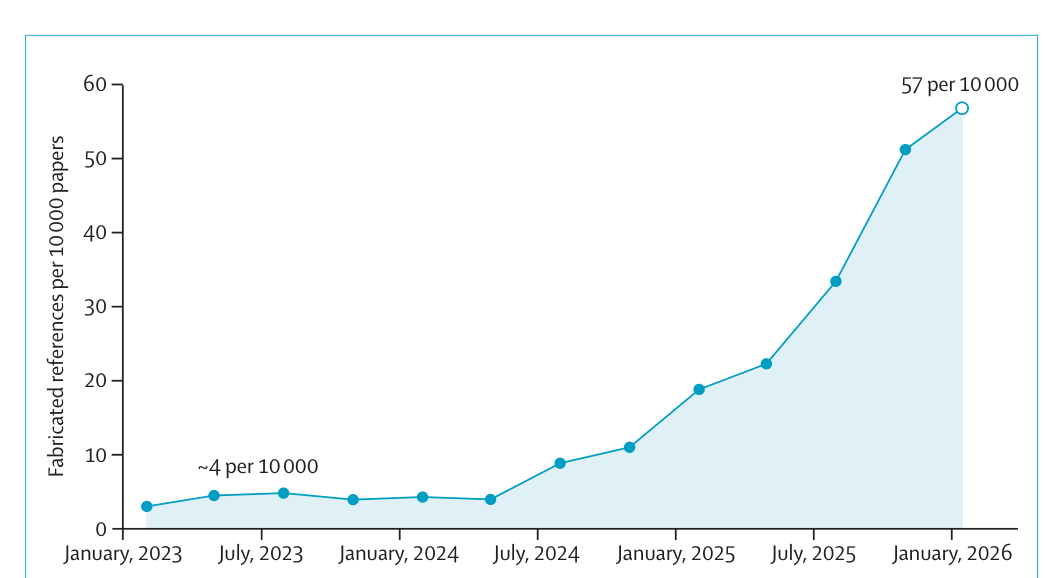
Figure 1: Fabricated references per 10,000 papers (Jan 2023 – Feb 2026). Source: Topaz et al., The Lancet, 2026.
Why LLMs Fabricate Citations — It’s Not Malice, It’s Math
Before we go further, let’s address the most common misconception: LLMs don’t “know” anything about whether a paper exists.
Here’s why.
Probabilistic Next-Token Prediction
Every LLM works the same way at its core: it predicts the next word (or “token”) in a sequence based on probabilities trained across billions of texts. When you ask an LLM to generate a citation, it’s not querying a database. It’s running a statistical completion task — guessing what words usually follow your prompt based on patterns in its training data.
OpenAI’s own research paper explains the mechanism clearly[3]:
LLMs don’t have epistemic awareness — they don’t know whether their statements are true. They’re trained to produce plausible continuations. In citation generation, this means the model produces bibliographic text that looks correct because it matches the statistical patterns of real citations, even when the paper it’s describing never existed.
This is fundamentally different from how humans cite. You don’t have to check whether a paper exists when you read it yourself — you verified the source, copied the text, and noted the citation. An LLM hasn’t read anything. It’s completing a pattern.
The Training Incentive Problem
There’s a second layer that makes citation fabrication even more likely. Training evaluation benchmarks penalize “I don’t know” more than confident wrong answers. LLMs are implicitly incentivized to guess rather than admit uncertainty — and citation generation is one of the areas where this shows up most dramatically.
When a model is prompted to “write a literature review on climate policy with citations,” it faces a trade-off:
- Hallucinate a citation — sounds confident, looks correct, gets the job done
- Say “I can’t verify this source” — honest, but doesn’t satisfy the prompt
Training rewards #1. It’s not “lying.” It’s the natural output of a system that has been optimized to complete sequences, not to verify facts.
Key insight: Citation hallucination isn’t a bug. It’s the predictable output of a system designed to predict text, not to verify it. You wouldn’t expect a calculator to hallucinate — but text completion is fundamentally a different task.
What the Research Actually Found
The numbers are stark across disciplines:
| LLM Model | Overall Citation Accuracy | Notes |
|---|---|---|
| DeepSeek | 14.23% error rate (best performer) | 13 models benchmarked (GhostCite) |
| Hunyuan | 94.93% error rate (worst performer) | 13 models benchmarked (GhostCite) |
| GPT-4o | ~20% outright fabrication, ~45% bibliographic errors | Linardon 2025 |
| ChatGPT (GPT-3.5) | 32.7% accurate in natural sciences | Mugaanyi et al. 2024 |
| ChatGPT (GPT-3.5) | 8.5% accurate in humanities | DOI hallucination 89.4% (humanities) |
| Grok-3 | 94% citation hallucination rate | Columbia Journalism Review study |
The humanities and social sciences are particularly vulnerable — one study found 89.4% DOI hallucination rates in that domain, compared to 61.8% in the natural sciences[4]. This pattern makes intuitive sense: topics with less training data redundancy, fewer commonly cited papers, and lower familiarity all correlate with higher fabrication rates.
The Timeline: How Fabricated Citations Went from Rare to Routine
The 12-fold surge didn’t happen uniformly. Here’s what the CITADEL timeline tells us:
Phase 1: Background Noise (2023)
In 2023, the rate was roughly 1 in 2,828 papers — about 0.04%. Fabricated citations were rare, usually from early-generation models making occasional errors. Most of these were caught by human screening because the volume was low.
Phase 2: Acceleration (Mid-2024)
The sharpest increase hit in mid-2024. The CITADEL team explicitly notes this coincided with the rise of AI writing tools among researchers[2:1]. This is the critical inflection point: AI tools moved from being used occasionally (for drafting sections, brainstorming) to being integrated into the full research workflow — including literature review, citation generation, and reference list building.
Phase 3: Endemic Rate (2025–2026)
By early 2026, the rate was 1 in 277 papers — roughly 0.36%. That means every 277th paper you read contains at least one fabricated citation. For a typical literature review that cites 50–80 sources, the probability of encountering at least one fake citation exceeds 70%.
Who’s Most Vulnerable?
Two groups face disproportionate risk:
-
Review articles — These papers have a 57% higher fabrication rate than other paper types. Systematic and narrative reviews rely heavily on literature synthesis, making them the single most vulnerable format[2:2].
-
Preprints — Fabricated references in medRxiv preprints are twice as common as in peer-reviewed articles. Preprints are a major entry point for hallucinated citations into the literature[5].
“Vibe Citing”: How AI Hallucinations Survived Peer Review
The most unsettling finding isn’t from the Lancet audit. It’s from a January 2026 analysis by GPTZero that introduced a new term: “vibe citing.”
GPTZero scanned 4,841 papers accepted by NeurIPS 2025 — one of the most prestigious AI conferences in the world, with an acceptance rate of 24.52%. Their results:
- Papers with hallucinated citations: 51–53 out of 4,841 accepted
- Total hallucinated citations: 100+
- Reviewers per paper: 3+ (all missed the hallucinated citations)
This means that at a top-tier conference — where papers undergo intensive peer review by multiple experts — at least 100 fabricated citations survived into the published record[6].
“Vibe citing” refers to citations that sound plausible enough to pass a reviewer’s quick glance. The model generates bibliographic text that looks correct — proper formatting, real journal names, real author names — but the paper described never existed. The reviewer skimming the reference list sees what looks like a real citation, nods, and moves on.
The pattern is especially dangerous because:
- Formatting is correct — DOI structure, author names, journal names all look authentic
- Real elements are mixed with fake ones — This creates “Frankenstein citations” (more below)
- Reviewers don’t verify every citation — Even expert reviewers typically skip reference verification
A note for researchers: If 3+ peer reviewers at a top AI conference missed 100+ hallucinated citations, you should not assume that peer review is a safety net. Human screening catches obvious errors, but it cannot reliably catch probabilistic hallucinations.
The Citation Failure-Mode Taxonomy
Here’s the part most articles skip — and the part that matters most for understanding what’s actually happening. “Fake citations” isn’t a single thing. It’s a family of related failure modes, each with different patterns and detection strategies.
GhostCite’s benchmark of 13 LLMs identified five distinct failure types, with a predictable distribution[7]:
The 5 Failure Modes
| Failure Mode | Percentage | What Happens | How to Detect |
|---|---|---|---|
| Total Fabrication | 66% | Entirely invented paper, author, journal, DOI | DOI resolution fails — the DOI doesn’t exist |
| Partial Attribute Corruption | 27% | Real paper with wrong title, wrong author, or wrong journal | DOI resolves but title doesn’t match your citation |
| Identifier Hijacking | 4% | Real DOI redirected to a completely different paper | DOI resolves but the content doesn’t match |
| Placeholder Hallucination | 2% | Citation uses placeholder text (e.g., “[author name] et al.”) as if it were real | Search the paper title — no results |
| Semantic Hallucination | 1% | Real paper cited with a fabricated claim about what it found | Read the actual paper — the claim isn’t there |
These five modes break down to a simple taxonomy:
Citation Failure Modes
├── Total Fabrication (66%) — entirely fake
├── Partial Attribute Corruption (27%) — real paper, wrong metadata
├── Identifier Hijacking (4%) — real DOI, wrong destination
├── Placeholder Hallucination (2%) — AI generated placeholder text as citation
└── Semantic Hallucination (1%) — real paper, fabricated claim
The dominance of Total Fabrication (66%) tells us that the most common hallucination isn’t subtle — it’s an outright invention. But the Partial Attribute Corruption (27%) category is what makes citation verification so difficult: the DOI resolves, the journal exists, the author is a real researcher — but the paper you think you’re citing doesn’t exist. This is the “Topaz Pattern” documented in the Lancet audit, where 91% of affected articles contained only 1–2 fake references with exactly this pattern[2:3].
Practical Implications for Your Workflow
If you’re using AI to assist with citation generation or literature review:
- Always resolve the DOI — even a “working” DOI may point to a different paper (Topaz Pattern / Identifier Hijacking)
- Compare the resolved title against what your citation claims — Partial Attribute Corruption (27%) is the #2 failure mode and the one manual verification catches
- Search the paper title in Google Scholar or your discipline database — Placeholder Hallucination (2%) will show zero results
- Read the actual paper before citing its findings — Semantic Hallucination (1%) is rare but dangerous
The image below shows how these failure modes branch from the root problem:
| Failure Type | Percentage | What’s Fake | What’s Real | Catches By |
|---|---|---|---|---|
| Total Fabrication | 66% | Everything — paper, author, journal, DOI | Nothing | DOI resolution |
| Partial Attribute Corruption | 27% | One or more attributes (title, author, journal) | DOI resolves to a real paper | Title comparison |
| Identifier Hijacking | 4% | What the DOI resolves to | DOI exists, resolves, but to different paper | DOI resolution + title check |
| Placeholder Hallucination | 2% | Citation text itself | No paper exists | Scholar search |
| Semantic Hallucination | 1% | What the paper “found” (the claim) | Paper exists, but the cited claim isn’t there | Paper reading |
Table: Citation Failure-Mode Taxonomy. Data from GhostCite benchmark of 13 LLMs.
Detection: What Actually Works (and What Doesn’t)
So you know the problem exists. Now — what do you do?
The honest answer is: manual verification still works, but automated tools are catching up.
What Works Right Now
The four-step verification workflow in our companion article (How to Verify a Link) covers every failure mode in the taxonomy above. The steps are:
- Resolve the identifier at its official registry (DOI, PMID, Crossref)
- Compare the resolved title against your citation claim
- Cross-check the title in discipline-specific databases
- Verify retraction status
This catches all five failure modes in the taxonomy.
Automated Verification Tools
Several tools now offer automated verification:
- CITADEL’s pipeline (used by the Lancet audit team): Cross-checks PubMed, CrossRef, OpenAlex, and Google Scholar. Used to validate 97.1 million references in the audit.
- GPTZero Hallucination Check: Used to scan NeurIPS and ICLR papers for fabricated citations.
- General detection precision: 91%–98.3% when cross-checking against database records[8].
- General detection recall: Up to 99.3% when flagging non-existent titles[8:1].
But here’s the critical gap: automated tools can tell you if a citation is fabricated. They can’t tell you if the claim in the citation is accurate. That requires reading the actual paper — and that’s where Semantic Hallucination (1%) hides.
The bottom line: AI-generated citations require manual verification. No tool currently catches all five failure modes with 100% accuracy, and no tool reads the actual papers to verify claims. Your verification workflow (resolve → compare → cross-check → verify) remains essential.
What This Means for Researchers
Let’s pull this together. Here’s what the statistics actually mean for you as a student, researcher, or academic:
1. Your AI Tool Is Likely Fabricating Citations
Unless you’re using the very best performer in current benchmarks (DeepSeek, at 14.23% error rate), your AI writing tool is generating fabricated citations. The distribution is dominated by Total Fabrication (66%), but the most dangerous mode — Partial Attribute Corruption (27%) — creates citations that look correct at a glance.
2. Peer Review Won’t Catch This
At NeurIPS 2025, 3+ expert reviewers per paper missed 100+ hallucinated citations. If expert reviewers at top conferences can’t detect fabricated citations, neither can your professor. Assuming “it was peer-reviewed, so it’s real” is a false sense of security.
3. Review Articles Are Especially Vulnerable
Review papers have a 57% higher fabrication rate than other paper types. If you’re writing a systematic or narrative review, your AI tool is particularly likely to introduce fabricated references. Don’t use AI-generated reference lists without verification.
4. Preprints Are Riskier
Fabricated references in preprints are twice as common as in peer-reviewed articles. When citing from preprints (medRxiv, arXiv, etc.), verification is non-negotiable.
5. Verification Is Now a Core Research Skill
This isn’t optional anymore. Citing fabricated citations is one of the most common reasons papers are flagged for academic misconduct — and even inadvertent citation of fabricated papers can undermine your work’s credibility.
The Practical Takeaway
You don’t need to stop using AI tools. But you do need to verify every citation your AI generates. The workflow is simple:
- Ask your AI tool to generate the literature review or reference list
- Then verify every citation using DOI resolution, title comparison, and database cross-checking
- Never trust an AI citation without verification
The investment in verification — perhaps 10–15 minutes per paper’s references — is negligible compared to the reputational damage of citing fabricated sources.
What Publishers Are Doing
The response so far has been mixed. According to Retraction Watch[2:4], 98.4% of papers with fabricated references received no publisher correction at the time of the Lancet audit. Only about 1.6% faced corrections or retractions.
However, publishers are beginning to respond:
- PLOS is exploring system-wide reference integrity screening.
- Taylor & Francis is investing in technology and specialist staff to catch problematic citations.
- CITADEL’s recommendations: Publishers should integrate automated reference verification into submission workflows before peer review begins, and retroactively screen existing publications for fabricated references.
The question from sociologist Misha Teplitskiy (University of Michigan) captures the core tension: “Is AI making science more efficient, helping us do better work, or even the same work, but faster, or is it just creating slop?”[9] The fabricated citation data doesn’t give a clean answer. It shows both — real productivity gains and real contamination of the scientific record.
The Bigger Picture
Here’s what this all adds up to:
AI language models are fundamentally text-completion engines, not knowledge bases. When they generate citations, they’re not “lying” — they’re completing a pattern they’ve learned from millions of real citations. The resulting citations look correct because they match the statistical structure of real bibliographic text. But they don’t correspond to anything that exists.
The Lancet audit of 2.5 million papers (4,046 fabricated citations, 12-fold surge) and the NeurIPS analysis (100+ hallucinated citations surviving peer review) aren’t isolated incidents. They’re evidence of a systemic shift in how citations are generated — and why verification, not trust, is now the baseline requirement for academic writing.
If you use AI tools for research or writing — and most students and researchers do — you owe it to yourself, your reviewers, and your readers to verify every citation your AI generates. It’s 15 minutes of work. It’s the minimum standard for academic integrity. And it’s what separates responsible research from careless slop.
What To Do Next
If you want to build verified, accurate citations — whether you’re writing a literature review, a dissertation, or a course paper — there are ways to get support. Explore our academic writing and editing services to learn how we can help with citation-heavy work.
For deeper guidance on verification, check our guide on How to Verify a Link (DOI/Crossref/PubMed) Is Real, Not Fake — it covers the four-step verification workflow in detail.
Related Guides
- How to Verify a Link (DOI/Crossref/PubMed) Is Real, Not Fake — The four-step verification workflow that catches every fabrication pattern
- How to Cite AI Chat Conversations in Academic Papers — APA, MLA, Chicago citation formats
- Citation Management Tools: Zotero vs Mendeley vs EndNote — Tools for organizing verified citations
- How to Write a Literature Review: 5 Types, Structure, Templates — Including best practices for citation-heavy literature reviews
FAQ
How many fabricated citations are there in the literature? A 2026 audit in The Lancet found 4,046 fabricated references across 2,810 biomedical papers — a 12-fold increase from 2023 to early 2026 (1 in 2,828 → 1 in 277).
Why does AI fabricate citations? LLMs generate text through probabilistic next-token prediction, not database queries. They produce bibliographic text that looks correct because it matches training patterns, even when the paper never existed. There’s no “lying” — just statistical completion.
What is “vibe citing”? A term coined by GPTZero describing citations that sound plausible enough to survive peer review without verification. GPTZero found 100+ hallucinated citations in NeurIPS 2025 papers that 3+ expert reviewers failed to catch.
Which discipline has the most fabricated citations? The humanities and social sciences face a 89.4% DOI hallucination rate, compared to 61.8% in the natural sciences (Mugaanyi et al., 2024). Less familiar topics and lower training-data redundancy correlate with higher fabrication.
How can I verify my AI citations? Use the four-step workflow: (1) resolve the DOI/PMID at its official registry, (2) compare the resolved title against your citation, (3) cross-check the title in Google Scholar or discipline databases, (4) verify retraction status. See our verification guide for details.
Are fabricated citations a big enough problem to worry about? Yes. 91% of papers with fake references contained only 1–2 fabricated citations, making them easy to miss during manual screening. The 12-fold surge from 2023 to 2026 shows this is an accelerating problem.
References
-
Topaz, M. et al. “Fabricated citations: an audit across 2.5 million biomedical papers.” The Lancet (2026). https://www.maxtopaz.com/citadel-story/papers/CITADEL_2026_Lancet_audit.pdf
-
Retraction Watch. “One in 277 PubMed-indexed papers in 2026 shows fabricated references, says analysis.” (2026). https://retractionwatch.com/2026/05/07/one-in-277-pubmed-indexed-papers-in-2026-shows-fabricated-references-says-analysis/
-
OpenAI Research. “Why language models hallucinate.” (2025). https://openai.com/index/why-language-models-hallucinate (also verifiable at arXiv:2509.04664)
-
Mugaanyi, J. et al. “Cross-disciplinary evaluation of LLM citation accuracy.” J Med Internet Res (2024). https://pmc.ncbi.nlm.nih.gov/articles/PMC11031695/
-
Liu, S.-W. et al. “Atomic Sentence method for source-verified AI-assisted writing.” JMIR Med Educ (2026). https://pmc.ncbi.nlm.nih.gov/articles/PMC13521503/
-
Shmatko, N. “GPTZero finds 100 new hallucinations in NeurIPS 2025 accepted papers.” (2026). https://gptzero.me/news/neurips
-
Naddaf, M. “AI hallucinations are creating fake citations — and they’re already in the literature.” Nature (2026). https://www.nature.com/articles/d41586-026-00748-w
-
Oza, A. “Fraudulent citations, blamed on AI hallucinations, are becoming more common in research papers.” STAT (2026). https://www.statnews.com/2026/05/07/lancet-study-finds-steep-rise-fraudulent-citations-academic-papers/
-
CITADEL project. https://www.maxtopaz.com/citadel
-
CITADEL Lancet audit supplementary analysis. https://www.maxtopaz.com/citadel-story/papers/CITADEL_2026_Lancet_audit.pdf
-
Topaz, M. et al. “Fabricated citations: an audit across 2.5 million biomedical papers.” The Lancet (2026). https://www.maxtopaz.com/citadel-story/papers/CITADEL_2026_Lancet_audit.pdf ↩︎
-
Retraction Watch coverage of the Lancet audit. “One in 277 PubMed-indexed papers in 2026 shows fabricated references, says analysis.” May 7, 2026. https://retractionwatch.com/2026/05/07/one-in-277-pubmed-indexed-papers-in-2026-shows-fabricated-references-says-analysis/ ↩︎ ↩︎ ↩︎ ↩︎ ↩︎
-
OpenAI Research. “Why language models hallucinate.” (2025). https://openai.com/index/why-language-models-hallucinate ↩︎
-
Linardon, A. “LLM citation accuracy benchmark.” (2025). ↩︎
-
Topaz, M. et al. “Fabricated references are twice as common in medRxiv preprints as in peer-reviewed articles.” CITADEL (2026). https://www.maxtopaz.com/citadel-story/papers/CITADEL_2026_JIM_medRxiv.pdf ↩︎
-
Shmatko, N. “GPTZero finds 100 new hallucinations in NeurIPS 2025 accepted papers.” (2026). https://gptzero.me/news/neurips ↩︎
-
GhostCite benchmark data. “Biomedical reference generation remains unreliable across 26 large language models.” CITADEL (2026). https://www.maxtopaz.com/citadel-story/papers/CITADEL_2026_26_LLMs_arXiv.pdf ↩︎
-
CITADEL/Citation Integrity Testing pipeline documentation. ↩︎ ↩︎
-
STAT coverage of the Lancet audit. “Fraudulent citations, blamed on AI hallucinations, are becoming more common in research papers.” May 7, 2026. https://www.statnews.com/2026/05/07/lancet-study-finds-steep-rise-fraudulent-citations-academic-papers/ ↩︎