

How to Write a Reflection Essay Using Gibbs’ Reflective Cycle


TL;DR — Quick Takeaways
- Gibbs’ Reflective Cycle has six stages (Description → Feelings → Evaluation → Analysis → Conclusion → Action Plan) and helps you turn any college experience into a structured, high-quality reflection essay.
- The most common mistake? Describing too much and analyzing too little. The Analysis stage should take 25–40% of your word count — not the Description stage.
- Gibbs was designed for general experiential learning, not just nursing. It works great for group projects, volunteering, leadership roles, study abroad, and first-time failures.
- The hardest part of any Gibbs essay is the transition from feelings to analysis — students write “I felt sad” and stop there. The trick is connecting your emotions to what they reveal about your learning process.
- If your assignment requires a structured, event-based reflection, Gibbs is usually the right model. For diffuse, ongoing experiences, consider DEAL or 5R instead.
Let’s break down exactly how to write a reflection essay that actually scores well.
What Is a Reflection Essay?
A reflection essay is not a diary entry. It’s not a journal. It’s a structured academic assignment where you examine a specific experience, identify what you learned, and articulate how that learning will shape your future work.
Think of it this way: every reflection essay starts with a concrete event — a group project that went wrong, a volunteering shift where you felt out of your depth, a leadership role where things didn’t go as planned. But unlike a diary entry, a reflection essay takes that event and turns it into evidence of growth.
The key difference between descriptive writing and reflective writing is simple:
- Descriptive writing tells what happened. (“My group presentation didn’t go well.”)
- Reflective writing asks why it mattered and what you learned. (“My group presentation didn’t go well because I assumed everyone knew the material — a lesson in assuming too much and communicating too little.”)
The second version is what professors want. They want to see the learning, not just the event.
Why do professors assign reflection essays? They want you to develop metacognition — the ability to think about your own thinking. Studies at La Trobe University confirm that reflective writing is “frequently used in professional education, including health sciences, education, and social work” because it develops critical self-awareness. That’s why the skill matters far beyond any single assignment.La Trobe University’s guide to reflective writing
What Is the Gibbs Reflective Cycle?
Gibbs’ Reflective Cycle was developed by Graham Gibbs in 1988 in a book titled “Learning by Doing: A Guide to Teaching and Learning Methods” — published by the Further Education Unit at Oxford Polytechnic (now Oxford Brookes University).
Here’s the crucial detail most students get wrong: Gibbs was NOT originally designed for nursing. It was designed for experiential learning broadly — for anyone who wants to learn systematically from their experiences. The nursing and healthcare applications came later, as practitioners adopted the model for clinical reflection.
The cycle has six stages, each asking a specific question:
- Description — What happened? (10-25% of your word count)
- Feelings — What were you thinking and feeling? (5-10%)
- Evaluation — What was good and bad about the experience? (10-15%)
- Analysis — What does it all mean? What can you learn? (25-40%)
- Conclusion — What else could you have done? (5-10%)
- Action Plan — If it happened again, what would you do? (5-10%)
The cycle is meant to be iterative — you can return to earlier stages as your analysis deepens. This circular diagram from the University of Edinburgh Reflection Toolkit shows the full flow with guiding questions for each stage.
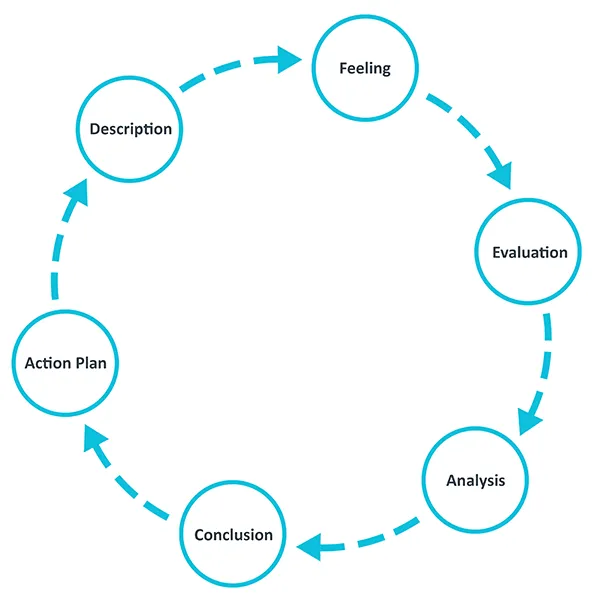
Source: University of Edinburgh Reflection Toolkit (original source URL: https://essays-panda.com/wp-content/uploads/2026/08/gibbs_cycle_600x600.png-5.webp)
Every stage builds on the previous one. You can’t analyze something you haven’t evaluated, and you can’t evaluate something you haven’t described. The structure prevents you from jumping straight to conclusions — which is exactly where most students rush and lose marks.
The Six Stages Explained (with College Examples)
1. Description — What Happened?
This is your factual baseline. Keep it brief (10-25% of your essay) and focus only on the essentials:
- Where did the event take place?
- Who was involved?
- What specifically happened?
- When did things go right or wrong?
Example: “During my sophomore year, I led a four-person group project for my Introduction to Business course. We had five weeks to prepare a market analysis presentation. In the first three weeks, we divided tasks and didn’t meet. In week four, I realized two members hadn’t started their sections, and my deadline anxiety made me take over their work myself.”
Keep this factual. Don’t analyze yet — just set the scene. Simple Psychology emphasizes that Description should “provide a clear, concise overview of the experience” without judgment or interpretation.Simply Psychology on Gibbs stages
2. Feelings — What Were You Thinking and Feeling?
This is where most students stumble. You’re not writing a diary — but you ARE being honest about your emotional response.
Example: “At first, I felt frustrated. Then I felt angry — at my teammates, at myself, and at the situation. By the day of the presentation, I was overwhelmed and anxious. Looking back, I think I felt defensive too, because I assumed they were irresponsible rather than struggling.”
Notice the pattern: describe the emotion, then hint at why it matters. This bridges the gap between raw feelings and later analysis. The University of Exeter’s reflective writing guide recommends using phrases like “I felt ___ because ___” to connect emotions to causes.University of Exeter reflective writing guide
3. Evaluation — What Was Good and Bad?
Now you judge the experience. What worked? What didn’t? Who contributed? Who didn’t?
Example: “The good: I learned how to manage tight deadlines and stepped up as a leader. The bad: I didn’t communicate earlier, I assumed responsibility instead of asking for help, and the group dynamic broke down because we treated the project as individual tasks rather than a collaborative effort.”
Notice that Evaluation is still descriptive — you’re naming strengths and weaknesses but not yet explaining why they occurred. That comes next.
4. Analysis — What Does It All Mean?
This is where your essay earns its marks. The Analysis stage should be your longest section (25-40% of total word count) because this is where you dig into the why behind everything.
Use the “why” questions aggressively:
- Why did I assume they were irresponsible?
- Why didn’t I communicate earlier?
- Why did treating the project as individual tasks lead to breakdown?
- What does this tell me about my working style?
Example: “My failure to communicate earlier wasn’t just bad time management — it reflected a deeper assumption I hold about collaboration: that I should trust people to deliver without checking in. This assumption comes from high school, where ‘leading’ meant delegating and following up was optional. But in college-level group work, that approach fails. My frustration wasn’t just about the project deadline; it was about my own unrealistic expectations about teamwork.”
This is where the double-loop learning concept (from Argyris & Schön) becomes relevant. Most students stop at single-loop learning: “Next time, I’ll set earlier deadlines.” Double-loop learning goes deeper: “Next time, I’ll question my assumption about how collaboration should work and discuss our working styles explicitly.”
The Structural Learning analysis by Paul Main (2023) identifies that many Gibbs reflections miss this deeper layer entirely, stopping at surface-level lessons.Structural Learning on Gibbs reflective cycle
5. Conclusion — What Else Could You Have Done?
Now step back and look at the big picture. What did you learn about yourself? What would you do differently?
Example: “I learned that leading doesn’t mean doing everything yourself. It means setting up structures for collaboration, checking in regularly, and communicating expectations clearly. I also learned that I’m more anxious about group work than I’d admit — and that anxiety makes me take over rather than trust.”
6. Action Plan — If It Happens Again, What Would You Do?
Your action plan must be specific, measurable, and linked to your analysis. Vague plans get vague grades.
Example: “For my next group project: I’ll schedule a 15-minute check-in at the start of each meeting to confirm progress. I’ll write down our collaboration expectations in the first meeting and share them in Slack. If a team member falls behind, I’ll ask ‘Is there a blocker?’ instead of assuming they’re not trying.”
See how each action directly connects to the analysis? That’s the difference between a strong Reflection essay and a weak one.
Word-Allocation Guide
One of the most useful but least-understood aspects of writing a Gibbs reflection essay is word count allocation. Most students front-load Description because it feels easiest — and then run out of words for Analysis, where the actual learning lives.
Below is a recommended breakdown for both common college essay lengths:
Word-Allocation Table
| Stage | Recommended % | 1,500-word essay | 2,000-word essay |
|---|---|---|---|
| Description | 10-25% | 150-375 words | 200-500 words |
| Feelings | 5-10% | 75-150 words | 100-200 words |
| Evaluation | 10-15% | 150-225 words | 200-300 words |
| Analysis | 25-40% | 375-600 words | 500-800 words |
| Conclusion | 5-10% | 75-150 words | 100-200 words |
| Action Plan | 5-10% | 75-150 words | 100-200 words |
Key takeaway: Your Analysis section should be the longest. If Description ends up being your longest section, you’re writing a diary — not a reflection essay.
La Trobe, Sheffield, and Exeter all confirm these ranges. Simply Psychology notes that “students often spend too much time describing and not enough analyzing” — and that’s exactly what professors penalize.Simply Psychology on Gibbs stages
Common Mistakes Students Make (and How to Fix Them)
Mistake #1: Confusing Evaluation with Analysis
This is the #1 reason students lose marks on Gibbs essays. Evaluation and Analysis serve entirely different purposes:
- Evaluation = What worked and what didn’t (judgment)
- Analysis = Why it worked or didn’t (explanation)
If you write “My group project failed because I didn’t communicate well” — that’s still Evaluation. You’re naming the problem but not analyzing the root cause. The fix: keep asking “why?”
Bad (Evaluation): “I should communicate more.”
Good (Analysis): “I didn’t communicate because I assumed everyone knew what to do. I learned that assumptions about teamwork are dangerous — college group work requires explicit communication structures.”
Mistake #2: Describing Too Much in the Feelings Stage
Writing “I felt sad and angry” is not enough. You need to connect feelings to the learning process:
Bad: “I felt sad about the group project.”
Good: “I felt frustrated because I believed I was carrying the entire project — a belief I hadn’t questioned until the presentation day. That frustration was the signal that my collaboration assumptions needed revision.”
Mistake #3: Vague Action Plans
“Next time I’ll try harder” is not an action plan. An actionable plan includes:
- Specific behaviors (“I’ll schedule weekly check-ins”)
- Measurable criteria (“I’ll confirm progress at each meeting”)
- Direct links to your analysis (“I’ll ask ‘what’s the blocker?’ instead of assuming”)
Mistake #4: Skipping the Cycle
Don’t jump straight to Analysis after Description. The Gibbs structure works because it forces you to process emotions (Feelings) and judge outcomes (Evaluation) before analyzing causes. Skipping stages means you’ll miss insights.
When to Use Gibbs vs. Other Models
Gibbs isn’t right for every reflection. College students frequently don’t know which reflective model fits their assignment — and using the wrong one can hurt their grade.
Here’s a comparison of the major reflective frameworks:
| Model | Best For | Structure | Strengths | When to Avoid |
|---|---|---|---|---|
| Gibbs’ Cycle | Event-based experiences with clear timeline (group projects, volunteering shifts, presentations) | 6 stages (Description → Feelings → Evaluation → Analysis → Conclusion → Action Plan) | Highly structured, forces analysis, clear template | Ongoing, diffuse experiences without a clear event |
| Kolb’s Cycle | Experiential learning cycles (internships, labs, fieldwork) | 4 stages (Concrete Experience → Reflective Observation → Abstract Conceptualization → Active Experimentation) | Emphasizes the learning cycle, great for hands-on subjects | Essays that require emotional processing |
| Driscoll’s Cycle | Quick professional reflection (teaching, mentoring, coaching) | 3 stages (What? → So What? → Now What?) | Simple, fast, great for brief reflections | Long-form academic essays |
| DEAL Model | Discipline-specific reflections (any field) | 3 stages (Describe, Express, Analyze, Learn) | Flexible, discipline-adaptable, emphasizes values | Strictly event-based assignments |
| 5R Model | Deep, critical reflection (identity, values, transformative experiences) | 5 Rs (Discover, Deface, Deepen,Restore, Reread) | Best for personal transformation, identity work | Standard college assignments requiring quick turnaround |
Rule of thumb: If your reflection is about a specific event with a clear before-and-after, use Gibbs. If your experience is ongoing or diffuse (like a semester-long study abroad), consider DEAL or 5R instead.Comprehensive model comparison — Post 5807
Step-by-Step: Writing Your Gibbs Reflection Essay
Step 1: Research the Experience First
Before you write a single word, identify the experience you’ll reflect on. It should be:
- Specific (not “college was challenging”)
- Meaningful (it genuinely affected you)
- Complete (you have enough perspective to analyze it)
Good examples: a group project where things went wrong, a leadership role, a study abroad moment, a volunteering shift where you felt out of your depth, a first-time failure.
Step 2: Brainstorm Using Gibbs Questions
Write brief notes under each stage heading. Don’t write full paragraphs yet — just answer each Gibbs question. This prevents you from rushing into Analysis without processing your feelings first.
Step 3: Draft Stage by Stage
Write each section separately, in order. The cycle structure works as a writing process too. Don’t jump ahead.
Step 4: Review the Feelings-to-Analysis Transition
Re-read from Feelings → Evaluation → Analysis. Does your analysis actually connect to your feelings? If Analysis suddenly drops into a new topic, the transition failed. The connection should feel natural.
Step 5: Check Word Allocation
Did Analysis end up being your longest section? If Description is longer, trim it and expand Analysis.
Template and Example
Here’s a complete text-based template you can adapt for any college experience:
# Introduction

[One paragraph: name the experience briefly and state the essay's purpose]

## Description
[Where, who, what happened. Keep factual. 10-25% of word count.]

## Feelings
[What you thought and felt. Connect emotions to causes. 5-10%]

## Evaluation
[What worked, what didn't. Naming strengths and weaknesses. 10-15%]

## Analysis
[Why things happened. The "why" behind everything. This should be your longest section: 25-40%. Connect double-loop learning.]

## Conclusion
[What you learned about yourself. The big picture. 5-10%]

## Action Plan
[Specific, measurable steps linked to analysis. 5-10%]

# Conclusion
[One paragraph: summarize the learning and its relevance to your future work.]
Short Example (Analysis Stage Only)
“My failure to check in with my team wasn’t just poor time management — it reflected a habit I picked up in high school where ‘leadership’ meant assigning tasks and following up was optional. In college-level group work, that approach fails because students have different working styles, competing deadlines, and varying levels of preparation. My frustration wasn’t just about the missing work; it was about my own unrealistic expectations about how collaboration should happen. This realization matters because it exposes a pattern: I default to assuming competence rather than verifying it. In future group work, I’ll explicitly discuss our working styles in the first meeting — not assume them.”
FAQ
Can I use Gibbs for any assignment?
Gibbs works best for event-based reflections — group projects, volunteering shifts, presentations, leadership roles, study abroad experiences, first-time failures. If your professor assigns a “reflective journal” covering ongoing experiences, DEAL or 5R might be better.Post 5807 model comparison
What if my experience wasn’t negative?
Gibbs works equally well for positive experiences. Instead of “what went wrong,” focus on “what worked, why it worked, and how I can replicate it.” The cycle doesn’t require a bad outcome — it requires learning.
How do I avoid sounding like I’m writing a diary?
Every feeling you describe should connect to a learning insight. If you write “I felt anxious,” immediately follow with “which revealed that I assumed ___.” The connection is what separates academic reflection from diary writing.How professors detect AI writing — avoid false flags
Is Gibbs suitable for group reflections?
Gibbs is actually ideal for group reflections because its Evaluation stage explicitly requires you to assess group dynamics, collaboration, and interpersonal effectiveness.La Trobe reflective writing guide
What’s the difference between Gibbs and Kolb?
Kolb is better for experiential learning cycles (labs, internships, fieldwork) where you’re building a skill through repeated practice. Gibbs is better for single-event reflections where you’re analyzing one specific experience.Post 5807 model comparison
Related Guides
Here are other essays-panda guides that complement this one:
- Reflection Essay Writing: Gibbs, 5R, and DEAL Models for College Students — A comprehensive comparison of all three major reflective frameworks, including when each model works best.
- How to Start a College Essay: 7 Hook Types + AI Detection — Strong openings that work for reflection essays too.
- Citation Styles Compared: APA vs MLA vs Chicago vs Harvard vs AMA vs CBE — Pick the right citation style for your discipline.
- Critical Thinking Strategies for College Students — Analytical frameworks that will deepen your Analysis section.
- How Professors Detect AI Writing — And How to Avoid False Flags — Maintain authenticity when writing about personal experiences.
- Student Mental Health and Academic Writing — How personal reflection connects to academic writing.
- Annotated Bibliography 2026 — Structuring academic sources to support your arguments.
Need Help?
Writing a reflection essay while juggling coursework, deadlines, and other assignments? Essays Panda provides custom-written academic papers tailored to your course requirements and deadline.
Visit essays-panda.com/order to get started.
Our writers specialize in academic reflection, case study analysis, and discipline-specific writing — and every paper is written from scratch with zero plagiarism.
References and further reading available at the University of Edinburgh Reflection Toolkit, Simply Psychology, La Trobe University LibGuides, and the Open University.