
How to Write a SOAP Note: Complete Clinical Documentation Guide for Nursing Students


A SOAP note is a structured clinical documentation format that organizes patient care into four sections—Subjective, Objective, Assessment, and Plan. It is one of the most widely used charting methods in nursing, helping bedside nurses, advanced practice nurses, and nurse practitioners communicate patient information clearly, accurately, and consistently across healthcare teams.
A SOAP note is not just a charting exercise—it is a clinical reasoning tool. When written correctly, it enhances communication among healthcare providers, streamlines documentation, and creates an organized record of a patient’s symptoms, diagnosis, treatment, and progress. More importantly, every SOAP note you write is a legal record. Write every entry as if it will be read in court.
Key Takeaways
- SOAP stands for Subjective, Objective, Assessment, and Plan — the four pillars of structured clinical documentation used by nurses and advanced practice providers.
- SOAP notes are increasingly used by bedside nurses (previously limited to physicians and APRNs), making this skill essential for all nursing students.
- The SOAPIE and SOAPIER extensions (Intervention, Evaluation, Revision) connect SOAP directly to the nursing process (ADPIE), adding practical value to your documentation.
- SOAP notes are legal records — they are primary defense in malpractice claims, so accuracy, timeliness, and objectivity are non-negotiable.
- The “must-not-miss” differential approach (most likely, less likely, must-not-miss) is a clinical reasoning framework used by nurse practitioners that helps structure your Assessment section for exam-ready precision.
What Is a SOAP Note?
SOAP notes break down patient documentation into four distinct sections, each serving a specific purpose in clinical communication. Understanding what belongs in each section is the foundation of effective SOAP note writing.
S — Subjective: Patient-Reported Information
The Subjective section captures information the patient reports about their experience — symptoms, feelings, history, and personal observations. These are the patient’s own words (or paraphrases of them), not your clinical interpretation.
Subjective data includes:
- The chief complaint (what brought the patient to your care)
- History of the present illness (HPI)
- Review of systems (ROS)
- Current medications and doses
- Known allergies
- Medical and surgical history
- Social history (when relevant to the encounter)
Example: A 3-year-old male presents with ear pain. The mother reports: “He’s been tugging at his right ear for two days. He’s feverish and crying more than usual. He had swimmer’s ear earlier this week — still on ofloxacin drops.”
This is a classic SOAP note pitfall: subjective data must come from the patient or their reported experience, not your assumptions.
O — Objective: Measurable and Observable Data
The Objective section contains signs — measurable, observable data collected during the patient encounter. These are facts you can verify, not interpretations.
Objective data includes:
- Vital signs (blood pressure, heart rate, respiratory rate, temperature, SpO2)
- Physical examination findings
- Laboratory results
- Imaging results (X-rays, MRI, CT scans)
- Patient behavior and appearance
- Diagnostic test data
Example: Same 3-year-old patient: “Vitals: Pulse 100, Resp 24, Temp 36.7°C (oral), SpO2 99%. Weight 34 lbs 4 oz, Height 3’2.5″. Right TM bulging, erythematous with purulent fluid; left ear normal. No conjunctival injection. Clear lungs bilaterally.”
Notice how the objective section is dense with measurable data. It reads like a clinical inventory — precise, factual, and free of interpretation.
A — Assessment: Clinical Analysis and Diagnosis
The Assessment section is where clinical reasoning shines. It synthesizes the subjective and objective data to arrive at a diagnosis or differential diagnosis. This is the heart of the SOAP note — the clinical judgment you bring as a nurse or nurse practitioner.
Elements of the Assessment include:
- Primary diagnosis (if identified)
- Differential diagnoses (what else could this be?)
- Clinical reasoning (why you chose the diagnosis you did)
- Nursing diagnoses (using NANDA-I framework)
Example: “Based on the subjective and objective information, the patient meets the criteria for an acute otitis media (AOM). The bulging, erythematous right TM with purulent fluid is the hallmark sign.”
P — Plan: Interventions and Next Steps
The Plan section outlines your treatment strategy, interventions, patient education, and follow-up. It connects the Assessment to actionable care steps.
Plan components include:
- Medications prescribed (name, dose, route, frequency)
- Interventions and procedures
- Patient education and teaching points
- Referrals and consultations
- Follow-up schedule
- Return precautions (when to come back)
Example: “Start oral amoxicillin 40 mg/kg/day in divided doses. Continue ofloxacin drops for the full seven-day course. Follow up in one week if symptoms do not improve. Return precautions: increased fever, worsening ear drainage, or refusal to eat.”
Pro tip: The Subjective, Objective, Assessment, and Plan sections work together like a chain — each building on the previous. Weak links in one section weaken the entire note.
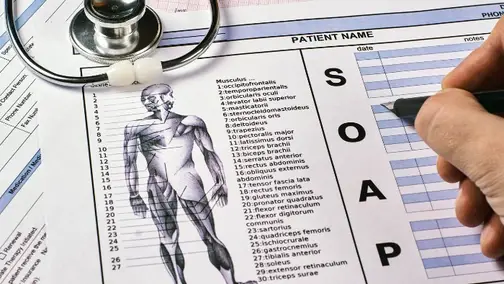
Source: Kathleen Gaines / Nurse.org — What Are SOAP Notes in Nursing
Complete SOAP Note Examples
Seeing SOAP notes in context makes the format click. Below are three complete examples — pediatric, adult med-surgical, and psychiatric — written specifically for nursing students.
Example 1: Pediatric SOAP Note
Patient: 3-year-old male, acute ear infection
Subjective:
- Patient is a 3-year-old male. Mother reports significant right ear pain for two days.
- Patient tugging at right ear, increased crying, reported feverish feeling.
- Seen earlier this week for bilateral ear pain after swimming; diagnosed with swimmer’s ear.
- Treated with ofloxacin five drops daily for seven days; course not finished.
- No known allergies, no current medications except ofloxacin drops.
Objective:
- Vitals: Pulse 100, Respiratory Rate 24, Temp 36.7°C (oral), SpO2 99%, Weight 34 lbs 4 oz, Height 3’2.5″
- General: Alert, no acute distress
- Head: Normocephalic, atraumatic
- Eyes: No conjunctival injection, no discharge
- Ears: Right TM bulging, erythematous with purulent fluid. Mild erythema in right ear canal. Left ear normal.
- Nose: Clear rhinorrhea
- Mouth/Throat: Moist mucosa, no lesions
- Neck: Supple, full range of motion
- Chest: Clear to auscultation, good aeration, no wheezing or crackles
- Cardiovascular: Regular rate and rhythm, no murmur
- Abdomen: Soft, non-tender, normal bowel sounds
- Skin: No rashes
- Lymph Nodes: No cervical adenopathy
Assessment:
- Acute otitis media (right-sided)
- Possible bilateral involvement (left ear normal on exam — rules out fully bilateral)
Plan:
- Start oral amoxicillin suspension 40 mg/kg/day in divided doses
- Continue ofloxacin drops for the full seven-day course
- Follow up in one week if symptoms do not improve
- Return precautions: increased fever, worsening drainage, refusal to eat
Example 2: Adult Med-Surgical SOAP Note
Patient: 45-year-old male, post-accident injury
Subjective:
- Patient is a 45-year-old male presenting to the emergency room with right hip, shoulder, and ankle pain.
- Pain began two days following a jet skiing accident.
- Patient states he lost control on the jet ski and flew off the back.
- Reports sharp and burning pain between the clavicle and rotator cuff with visible swelling and bruising.
- Wife reports patient taking Tylenol around the clock for the last two days.
- Patient rates pain at 8/10 but is unable to differentiate which area hurts most.
Objective:
- Vitals: Pulse 104, Resp 22, Temp 37.3°C (oral), SpO2 96%, Weight 274 lbs 1 oz, Height 5’8″
- General: Alert, reports 8/10 pain, unable to specify location precisely
- Right shoulder: Bruising and swelling, limited range of motion
- Right ankle: Swelling and bruising
- Extremities: Scattered bruising noted throughout body
- Neuro: No focal deficits
Assessment:
- Suspected dislocated right clavicle
- Right ankle sprain
- Multiple contusions
- Pain 8/10, acute
Plan:
- Administer pain medications as ordered
- Keep ankle elevated, apply ice
- Patient admitted to orthopedic floor once bed available
- Pending imaging (X-ray right shoulder, right ankle)
- Follow up with orthopedic surgery consult
Example 3: Psychiatric SOAP Note
Patient: 28-year-old female, anxiety and depression management
Subjective:
- Patient is a 28-year-old female presenting for follow-up on anxiety and depression.
- Reports feeling “overwhelmed” and “on edge” for the past six weeks.
- Describes difficulty sleeping (falls asleep around 2 AM, waking multiple times).
- Reports appetite changes (eating significantly less).
- States: “I can’t focus at work anymore. I keep thinking the worst thing will happen.”
- Denies suicidal ideation, denies hallucinations or delusions.
- Patient takes sertraline 50 mg daily as prescribed.
Objective:
- Vitals: BP 118/76, HR 88, Temp 36.8°C, SpO2 99%
- General: Well-appearing, dressed appropriately
- Affect: Constricted, anxious
- Mood: “Sad and anxious”
- Speech: Normal rate, volume, and tone
- Thought process: Linear, goal-directed
- Insight: Good
- Judgment: Fair
- No suicidal or homicidal ideation
Assessment:
- Generalized anxiety disorder with comorbid depression (F41.1, F32.1)
- Moderate severity — symptoms interfering with occupational and social functioning
- Patient is adherent to current medication regimen
Plan:
- Continue sertraline 50 mg PO daily; consider increasing to 100 mg if no improvement in two weeks
- Refer to outpatient therapy (cognitive-behavioral therapy)
- Psychoeducation on sleep hygiene and anxiety management techniques
- Follow up in two weeks; return sooner if mood worsens or suicidal thoughts develop
SOAP vs SOAPIE vs SOAPIER: Extensions You Need to Know
While SOAP is the most common documentation format, two extensions exist that add value for nursing students — and you should know when to use each.
Understanding the Extensions
SOAPIE adds two components:
| Component | Stands For | Purpose |
|---|---|---|
| I | Intervention | Measures taken to achieve expected outcomes |
| E | Evaluation | Analysis of intervention effectiveness |
SOAPIER adds one more component:
| Component | Stands For | Purpose |
|---|---|---|
| R | Revision | Changes from the original plan when outcomes fall short |
The ADPIE Connection
Here is why this matters for nursing students: the SOAPIE/SOAPIER extensions directly map to the nursing process (ADPIE) you already study.
- Assessment in SOAP ≈ Assessment in ADPIE
- Plan in SOAP ≈ Design/Planning in ADPIE
- Intervention in SOAPIE ≈ Implementation in ADPIE
- Evaluation in SOAPIE ≈ Evaluation in ADPIE
- Revision in SOAPIER ≈ Revising the care plan (the iterative nature of nursing)
Key insight: Bedside nurses are increasingly using SOAP notes (previously limited to physicians and APRNs). Nurse.org reports that the SOAPIE/SOAPIER extensions reflect nursing-specific practice more naturally than the original SOAP format. The “E” for Evaluation is what makes SOAP fundamentally a nursing format — it closes the loop on patient outcomes.
When to Use SOAP vs SOAPIE vs SOAPIER
| Format | Best Used For | When to Choose It |
|---|---|---|
| SOAP | Quick clinical encounters, concise charting | Routine shifts, fast-paced environments |
| SOAPIE | Academic assignments, thorough patient care | Clinical rotations, care plan assignments |
| SOAPIER | Complex cases requiring plan adjustments | Patients with changing conditions, follow-up visits |
The “Must-Not-Miss” Differential Approach
This is one of the most clinically valuable frameworks you will encounter — and it is absent from most SOAP note guides online.
The “must-not-miss” differential approach, popularized by nurse practitioner educator Victoria Sanderson of NP Reasoning, structures the Assessment section using three tiers of diagnostic reasoning:
- Most likely diagnosis — The diagnosis that fits best with the subjective and objective data
- Less likely diagnoses — Alternatives you considered and ruled out (or partially ruled out)
- Must-not-miss diagnoses — Life-threatening or time-critical conditions you must explicitly address, even if your working diagnosis seems clear
Clinical reasoning tip: This framework trains you to think like a clinician, not like a checklist. Instead of jumping to your first guess, you force yourself to consider the full differential — including diagnoses you cannot afford to miss.
Applying the Framework
Let’s use the adult dermatology example from nurse.org. The patient is a 40-year-old male with a rash on his back and arms that worsens after swimming and showering. Using the “must-not-miss” framework:
Assessment (structured with the “must-not-miss” approach):
- Most likely diagnosis: Eczema flare (atopic dermatitis) — patient reports rash worsens after swimming/showering, physical exam shows erythematous raised pruritic papules and patches with significant thickening. No crusting, oozing, or scaling.
- Must-not-miss diagnoses ruled out: Cellulitis — no systemic symptoms, no tenderness, no purulence, no fever. Contact dermatitis — possible given patient reports rash worsens with water exposure, but lack of vesicular lesions makes this less likely.
- Less likely diagnoses: Psoriasis (would typically show silvery scaling), fungal infection (no peripheral clearing or central clearing pattern).
This approach does two things at once: it structures your clinical reasoning clearly, and it creates a documented defensive posture — you addressed the critical diagnoses even if they were unlikely. That is a skill nurses and nurse practitioners need in real practice.
Legal Defensibility: SOAP Notes as Legal Records
Here is something nursing programs don’t always emphasize enough: every SOAP note you write is a legal document.
Why Legal Defensibility Matters
According to Herzing University and legal experts like Carstens, SOAP notes are the primary defense in medical malpractice claims and disciplinary proceedings. If it is not documented, it did not happen. If it is documented inaccurately, it can be used against you.
Carstens outlines key documentation best practices:
- Avoid overly zealous language — Do not make definitive claims you are not prepared to defend
- Double-check for errors — Documented errors can be more damaging than the original clinical decision
- Keep notes concise — Unnecessary narrative creates vulnerabilities
The NPUAP “Back-Staging” Example
The National Pressure Ulcer Advisory Panel (NPUAP) standards explicitly forbid “back-staging” — documenting a healing wound as going from Stage 3 to Stage 2 simply because the wound has improved. This is a documented legal vulnerability.
Legal risk: If a wound improved from Stage 3 to Stage 2, the correct approach is to document the current stage as Stage 2. “Back-staging” (reporting the prior stage first, then the current stage) creates a false narrative that can be challenged in court.
The lesson for nursing students? Documentation accuracy is not just about quality grades — it is about professional and legal liability. Write precise, accurate, and timely entries. Your future self will thank you.
Common Mistakes (and How to Fix Them)
Even experienced nursing students make these documentation errors. Here are the most common — and how to correct them.
Mistake 1: Confusing Subjective and Objective Data
This is the single most common SOAP note error students make. Subjective = patient-reported. Objective = clinician-measured.
| Mistake | Correction |
|---|---|
| “Patient appears anxious” in the Objective section | Move to Subjective or rewrite as “Patient reports feeling anxious” |
| “Patient states their pain is 8/10” in the Subjective section | This is actually correct — patient-reported pain is subjective. Keep it there. |
| “Wound measuring 4 cm” in the Subjective section | Move to Objective — this is measurable data, not patient-reported |
Mistake 2: Using Vague or Non-Specific Language
- Avoid: “Patient is feeling better” — What does this mean clinically?
- Use: “Patient reports decreased pain, from 8/10 to 4/10, after analgesic administration”
Mistake 3: Delaying Documentation
Write SOAP notes promptly — ideally immediately after the patient encounter. If you cannot write a complete note at that time, take quick notes and return to complete them as soon as possible.
- Why: Memory fades, especially in fast-paced clinical environments. Delayed documentation compromises accuracy.
Mistake 4: EMR Template Misuse
EMR templates can copy-paste inaccurate default information — medication lists, prior exam findings, or diagnostic impressions that are not actually current for your patient.
NP Reasoning’s warning: Templates are designed to save time and enforce documentation standards, but they do not replace your diagnostic reasoning process. Read through every field before signing. If the template says “Patient is allergic to penicillin” but your assessment finds no allergy, document the correction.
Mistake 5: Over-Charting (Including Irrelevant Information)
SOAP notes should be concise. Include relevant information only. Extraneous details create clutter and reduce readability for other providers reviewing the chart.
Tips for Better SOAP Notes
Quick-Reference Checklist
Use this checklist every time you write a SOAP note:
- S — Subjective: Does it include chief complaint, HPI, medications, and allergies?
- O — Objective: Are all vital signs included? Are physical exam findings specific and measurable?
- A — Assessment: Have you linked subjective and objective data to your diagnosis? Did you consider differential diagnoses?
- P — Plan: Are interventions clear? Is follow-up scheduled? Are return precautions included?
Template Best Practices
- If your clinical site provides EMR templates, use them as mental checklists, not as auto-fill shortcuts.
- Customize template defaults to match the actual patient encounter.
- Never copy-paste without verification.
Professional Tone Guidelines
- Maintain consistency across notes (terminology, structure, formatting).
- Use proper medical and nursing terminology.
- Keep a professional tone — document facts, not opinions.
- Follow HIPAA privacy laws at all times.
- Continue documenting throughout the patient’s hospitalization or encounter.
Summary: Your SOAP Note Game Plan
Writing strong SOAP notes is a skill that compounds over your entire career. Here is the essential takeaway:
SOAP notes are clinical reasoning tools, communication frameworks, and legal records — all at once. Mastering the format means mastering each of those dimensions.
Key Takeaways for Success
- Structure matters: Keep Subjective, Objective, Assessment, and Plan distinct and complete.
- Be specific: Vague documentation is vulnerable documentation.
- Be timely: Write notes immediately after encounters when possible.
- Think in tiers: Use the “must-not-miss” differential approach to strengthen your Assessment.
- Verify everything: EMR templates save time, but they can introduce errors. Always verify.
- Know the law: Every note is a potential legal record. Document like you expect it to be read in court.
Next Steps
- Practice writing SOAP notes using the three worked examples in this guide.
- Compare your notes against the examples — look for gaps in Subjective or Objective data.
- Use the checklist above as a template for your own documentation.
- Cross-reference with our Nursing Case Study Analysis: ADPIE Framework guide to connect SOAP note writing to the broader nursing care plan process.
- Review our Nursing Research Paper Writing: Evidence-Based Practice Guide for deeper insight into clinical reasoning.
Need help structuring your SOAP notes or drafting clinical documentation assignments? Our professional writers specialize in nursing content and can help you produce polished, accurate documentation guides, clinical reflections, and case study analyses. Order your custom nursing essay today — get high-quality, original papers written by experienced academic writers within your deadline.
Related Guides
| Guide | Description |
|---|---|
| Nursing Case Study Analysis: ADPIE Framework with 5 Real Patient Examples | Connect SOAP notes to the ADPIE nursing process with real patient examples. |
| Nursing Research Paper Writing: Evidence-Based Practice Guide | Master evidence-based documentation and research writing for nursing. |
| Nursing Essay Examples: Complete Guide | Nursing essay topics, structure, and samples for all academic levels. |
| Custom Writing for Nursing Majors: Why General Writers Fail | Understand why nursing-specific writing expertise matters. |
| 110+ Capstone Project Ideas for Nursing & Business | Inspiration for your capstone project and clinical documentation topics. |