How to Check for Retracted Papers: Complete Guide 2026


- Retraction Watch has over 60,000 records. Checking citations before submission is not optional, it’s mandatory.
- A “clean” reference list can become contaminated months after you wrote your first draft, when a previously acceptable paper gets retracted
- Zotero alerts cover ~75% of retractions (combine them with manual checks for completeness)
- The three-branch workflow from CASRAI gives you a clear decision tree for what to do when you find a retracted citation
- ICMJE explicitly assigns responsibility to the citing author, not the journal or database
What Is a Retraction? (And Why It Matters for Your Paper)
A retraction is a formal statement issued by a journal or publisher indicating that a published research paper should no longer be considered a reliable part of the scientific record. It does not mean the paper simply disappears. The article remains accessible, usually with a large “RETRACTED” watermark across the full text, and the retraction notice itself is linked from the article page.
Papers get retracted for a wide range of reasons. Some of the most common include:
- Honest errors in data, methodology, or analysis that are discovered after publication
- Research misconduct such as data fabrication, plagiarism, or image manipulation
- Ethical violations like conducting clinical trials without proper IRB approval
- Peer review problems when compromised reviews are detected
- Duplicate publication when the same data appears in multiple papers
The Retraction Watch Database currently tracks over 60,000 retracted, corrected, and concern-flagged records across the scientific literature. A 2026 analysis found that retractions still represent under 1% of the literature overall, but the sheer volume means hundreds of publications receive retraction notices every single month.
Here’s the problem most students don’t realize: a paper can sit in the literature, cited repeatedly, for years before an investigation concludes and a retraction notice is issued. A 1991 clinical study was retracted after 30 years, in 2022. That means a citation you added months or years ago can be retracted after you’ve already built your argument on it.
This is exactly why checking references is not a one-time step. It has to be an ongoing check.
How to Check for Retracted Papers — Your 4-Step Verification Workflow
Before you submit anything, run through this verification sequence. It takes about 15 minutes and catches the specific failure mode of unknowingly building an argument on a retracted source.
Step 1: Check every reference against PubMed’s retracted publication filter. Search Retracted publication[pt] combined with your reference’s title, author, or PMID. This is the International Committee of Medical Journal Editors’ own recommended method.
Step 2: Cross-check the key papers against the Retraction Watch Database. It indexes more retractions than any single publisher database and includes corrections, expressions of concern, and retractions not always immediately reflected in PubMed.
Step 3: Check the DOI directly on the publisher’s site. Publishers participating in Crossref’s CrossMark service embed a status badge on the article page. A retracted article should be visibly watermarked “RETRACTED” across the abstract and full text.
Step 4: Re-check just before final submission, not only when you first added the citation. A reference that was clean when you wrote the first draft can be retracted months later while your manuscript is still in revision.
Step-by-Step: Checking the Retraction Watch Database
The Retraction Watch Database is the largest structured index of retractions available, operated by the Center for Scientific Integrity, a US 501(c)(3) nonprofit. It is free to search with no registration required.
How to Search
The search form exposes several fields. Understanding which are free-text and which are constrained dropdowns changes how you should query them:
- Author (free-text name search). Useful for checking a specific individual’s publication record.
- Title — free-text search of the retracted article’s title.
- DOI or PMID (the fastest path when you already have a specific article identifier and just need a yes/no retraction check).
- Journal (dropdown of known journal titles). Useful for auditing a specific journal’s retraction history.
- Affiliation(s) (free-text matching institution name). Useful for an institution-level due-diligence check.
- Retraction/Notice Date (accepts date ranges). You can separate “when was it published” from “when was it retracted.”
When you search more than one field, the database applies Boolean AND logic across fields by default. Within a single free-text field, you can use AND, OR, and AND NOT operators explicitly.
What the Reason Categories Mean
Every record in the database carries one or more Reason tags assigned by the database team. The categories fall into rough groups:
- Misconduct (falsification of data, image manipulation, plagiarism, paper mill)
- Honest error (errors in data, methods, results, or conclusions)
- Research ethics (lack of IRB approval, consent issues)
- Publication-process issues (compromised peer review, conflict of interest)
- Data concerns (unreliable data, unreproducible results)
Always read the specific Reason tag on a record rather than treating “retracted” as a single undifferentiated red flag. An author unresponsive retraction (a procedural gap, often with no data-integrity implication at all) reads very differently from a data falsification retraction, even though both appear identically as “retracted” in a citation manager.
Quick tip: Search for the article’s title or DOI first. If you find a match, read the reason tag and the underlying retraction notice before deciding whether to replace or remove the citation. The reason matters for whether your own citation is actually affected.
Step-by-Step: Setting Up Zotero Alerts for Retracted Articles
If you use Zotero as your reference manager, you can set up automatic retraction warnings without needing to sync your library or upload a list of items to Zotero servers.
Zotero partnered with Retraction Watch to provide automatic checking. Here’s how it works:
- Retracted publications are flagged in your items list with a warning banner at the top of the item pane
- If you try to cite a retracted item using the word processor plugin, Zotero will warn you and confirm that you still want to cite it
- If you’ve already added a citation and it later gets retracted, Zotero will warn you the next time you update the document’s citations
Zotero calculates a non-unique identifier for each item in your library and compares those against a list of similar partial identifiers retrieved from Zotero servers. The servers have no way of knowing whether you actually have the retracted work in your library.
The ~75% Coverage Limitation
The current feature is limited to items with a DOI or PMID. This covers about 75% of the Retraction Watch data. Zotero cannot yet check items without identifiers, and they plan to support those in a future update.
This means students relying solely on Zotero will miss about a quarter of retractions. If you need completeness, combine Zotero alerts with a manual Retraction Watch check for the full reference list.
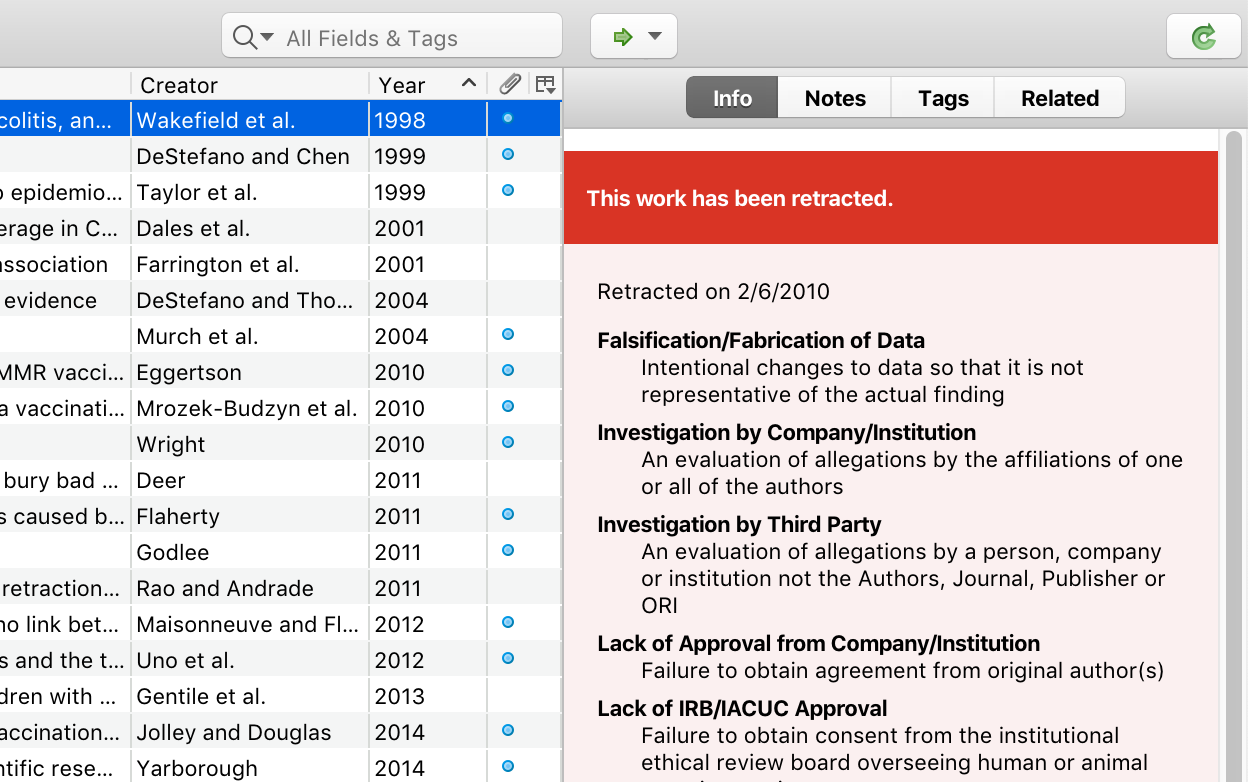
Zotero’s native retraction-warning banner (author: Zotero Project)
Step-by-Step: Using PubMed and CrossMark to Spot Retracted Publications
PubMed and CrossMark are two complementary tools that surface retraction status through different mechanisms.
PubMed’s Retraction Label
PubMed labels retracted records with the publication type “Retracted Publication” and links to the retraction notice from the citation itself. ICMJE’s own suggested method is to search PubMed using the publication-type filter Retracted publication[pt], or to browse PubMed’s dedicated list of retracted publications directly.
The PubMed filter is particularly useful because it covers the biomedical literature, the largest single indexed body of peer-reviewed journals in the life sciences. However, PubMed’s coverage is limited to indexed biomedical literature and does not extend to fields outside the life and medical sciences.
CrossMark Badges on Publisher Pages
If a publisher uses CrossMark, a service by the DOI agency Crossref, you can see the article’s status after clicking the CrossMark icon on the article page. A red crossmark symbol indicates the paper has been withdrawn, and clicking it reveals the retraction notice.
Adding the text “RETRACTED” at the title is good enough for human readers, but the metadata of the article should also tag retraction status. Crossref’s metadata schema includes a formal “retraction” update-type relationship between a DOI and its retraction notice.
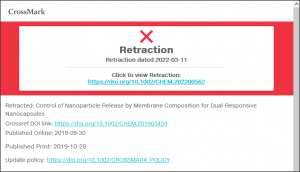
CrossMark badge showing retraction status on the publisher’s article page (author: HKUST Library, Aaron Tay)
What Journal Websites Show
When a journal retracts an article, it normally issues a retraction notice. On the webpage of the original article, the word “RETRACTED” is often added to the title. Some journals take down the original article page entirely and redirect the DOI to the retraction notice.
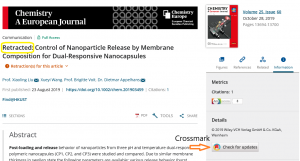
Journal website retraction watermark (author: HKUST Library, Aaron Tay)
What to Do When You Find a Retracted Citation (The Three-Branch Workflow)
This section is the most important part of the article. What you do depends entirely on which of three situations you are in. This decision flow comes from the Center for Advancement of Research Integrity and the International Committee of Medical Journal Editors’ shared guidance.
The Three Branches
Branch 1: Pre-submission. Your manuscript is not yet submitted, or still under review.
Action: Remove or replace the citation, or keep it only to discuss the retraction itself. This is a pre-submission fix. No correction process needed.
Consequence of inaction: Submitting with a retracted citation undermines the credibility of your paper and may lead to reviewer questioning.
Likely outcome: Clean, corrected reference list. No further action required.
Branch 2: Post-publication, peripheral. Your paper is already published. The retracted reference was peripheral. It provided background context, related work, or general framing. It was not central to your methods or conclusions.
Action: Contact the journal to request a correction (erratum) to the reference list. Your own conclusions stand unaffected.
Consequence of inaction: Your published paper cites invalid sources. Readers building on your work will encounter the retracted paper’s findings instead of the corrected record.
Likely outcome: A short corrigendum published alongside your paper, correcting the reference without implication about your findings.
Branch 3: Post-publication, load-bearing. Your paper is already published. The retracted reference supplied data, a method, or a claim your own conclusions actually depend on.
Action: Contact the journal immediately. Depending on severity, this can require your own correction, an expression of concern, or (rarely) retraction of your paper.
Consequence of inaction: Further papers may build on your conclusions, compounding the error. This becomes a structural integrity problem for the scientific record.
Likely outcome: The journal assesses whether your paper needs a correction, an expression of concern, or in serious cases a retraction of its own. This is not punitive. Being the one who flags it, rather than waiting for someone else to, is treated as good-faith diligence.
The Decision Table
| Scenario | What to Do | What Happens If You Don’t Act | Likely Outcome |
|---|---|---|---|
| Manuscript not yet submitted (or still under review) | Remove or replace the citation. Keep it only if discussing the retraction itself. | You submit with invalid references. Reviewers may flag it or your paper loses credibility. | Simple reference fix. No formal correction process needed. |
| Paper already published — retracted reference is peripheral (background context, not load-bearing for your findings) | Contact the journal’s editorial office. Request a correction (erratum) to the reference list. | Readers cite your paper relying on an invalid source. Your paper’s credibility erodes silently. | Published corrigendum correcting the reference. Your conclusions stand. |
| Paper already published — retracted reference is load-bearing (supplied data, method, or claim your conclusions depend on) | Contact the journal immediately. Re-examine whether your conclusions still hold without it. | Further papers build on your conclusions. The error compounds across the scientific record. | Journal may issue a correction, expression of concern, or (rarely) retraction of your own paper. |
| You just want to check your reference list before submission | Search each reference against PubMed’s Retracted publication[pt] filter AND the Retraction Watch Database. Check DOI on publisher site. |
You miss a retraction that happened after you first added the citation. Your draft looks clean but isn’t. | Reference list verified before submission. No surprises later. |
Why This Workflow Matters More Than You’d Think
Retractions have risen sharply over the last decade. Paper-mill-driven mass retractions (Hindawi’s 2023 wave alone contributed heavily to a roughly 8,000-retraction year) mean a citation you added months or years ago can be retracted after you’ve already built on it. A paper can also sit in the literature, cited repeatedly, for years before an investigation concludes and a retraction notice is issued.
The workflow diagram below shows the decision flow at a glance:
┌─────────────────────────────────┐
│  Do you have a retracted        │
│  citation in your references?   │
└──────────┬──────────────────────┘
           │ Yes
           ▼
┌─────────────────────────────────┐
│  Is your manuscript not yet     │
│  submitted (or still under      │
│  review)?                       │
└──────────┬──────────────────────┘
           │ Yes → Fix references. Simple replacement.
           ▼ No
┌─────────────────────────────────┐
│  Is the retracted paper already │
│  published?                     │
└──────────┬──────────────────────┘
           │ Yes → Check how load-bearing it is.
           ▼
┌───────────────┐───────────────────────────────┐
│ Peripheral    │               │ Load-bearing  │
│ (background,  │               │ (supplied     │
│  not central) │               │  data/method) │
│               │               │               │
│ → Correction  │               │ → Assess      │
│ → Erratum     │               │  impact on    │
│               │               │  conclusions  │
└──────┬────────┘               └──────┬────────┘
Three-branch workflow for handling retracted citations (text-based decision flow)
The ICMJE Standard
The International Committee of Medical Journal Editors puts this responsibility on the citing author directly, not just on journals and databases. Their manuscript-preparation recommendations state plainly:
“Authors are responsible for checking that none of the references cite retracted articles except in the context of referring to the retraction.”
This is not guidance. This is a requirement. If you submit to a medical journal indexed in MEDLINE, PubMed is considered the authoritative source for information about retractions.
ICMJE and COPE Requirements for Authors
The ICMJE recommendations make the requirement clear:
“References should be verified using either a bibliographic source, such as PubMed, or original sources. Authors are responsible for checking that none of the references cite retracted articles except in the context of referring to the retraction. For articles published in journals indexed in MEDLINE, the ICMJE considers PubMed the authoritative source for information about retractions.”
COPE, the Committee on Publication Ethics, treats unknowing citation of retractions as good-faith diligence. Being the one who flags a retracted reference is not an admission of wrongdoing. It’s the expected professional behavior. COPE’s guidelines describe the retraction process as a normal, non-punitive part of correcting the scholarly record.
What Not to Do
- Don’t silently delete the reference in a revised proof or preprint update and say nothing. If the paper is already published under a DOI, silently editing it isn’t an option. The correction has to go through the journal.
- Don’t assume a retraction means the underlying data is automatically wrong. Papers are retracted for reasons ranging from data fabrication to honest error to duplicate publication. The retraction notice itself will state the reason. Read the notice, not just the “RETRACTED” watermark.
- Don’t cite a retracted paper for its findings even with a caveat, once you know. ICMJE’s exception is narrow: you may reference a retracted article specifically to discuss the retraction (for example, in a paper about research integrity or paper mills), not to rely on its now-withdrawn findings.
- Don’t wait for a co-author or reviewer to catch it. If you find it first, flagging it yourself is the version of this that reflects well on you professionally.
Automated Checking Tools You Should Know About
Several tools help surface retraction status without requiring manual checks. Here’s what’s available.
Zotero (Free)
Zotero’s retraction integration is built-in and free. As covered above, it flags retracted items in your library and warns you when you try to cite them. The privacy design is thoughtful: Zotero calculates anonymized identifiers and compares them against retraction data on Zotero servers. The servers cannot tell which specific paper you are checking.
Thrix
Thrix offers automatic Retraction Watch checking within document editing. It reads DOIs from your references, cross-checks them against the database, and flags matches inline. When you process a document or reference list in Thrix, each DOI is checked against Retraction Watch and results appear as comments within the document. This catches potential issues during editing, rather than being discovered after publication.
scite.ai Reference Checks
scite’s Reference Checks generates a report alerting you if it finds any problematic references. It checks citations as supported, disputed, or retracted. scite does not use Retraction Watch data directly, relying on other data sources and its own algorithms instead. The coverage may differ from tools that are based on the Retraction Watch Database.
Crossref API
Crossref now serves Retraction Watch data directly via API. If a tool uses Crossref’s REST API, retractions appear in the update-type field with source: "retraction-watch" or source: "publisher". The data is freely available and picks up new entries immediately. Tools that ingest Crossref metadata automatically start surfacing retraction status as the data arrives.
Common Mistakes When Checking for Retracted Papers
Even experienced researchers make mistakes. Here are the most common pitfalls students encounter.
Mistake 1: “I checked once, so I’m good.”
A reference that was clean when you wrote the first draft can be retracted months later while your manuscript is still in revision. You add a paper in September. It gets retracted in January. Your paper is submitted in February. Checking once is not enough. Run the check right before final submission.
Mistake 2: Assuming “retracted” means the same thing across all records
The Retraction Watch Database assigns detailed Reason tags. An honest error in data analysis reads very differently from data falsification. If you’re building an argument and a cited paper is retracted for a procedural reason (e.g., author unresponsive, missing consent forms), the underlying science may still be sound. Read the reason before deciding whether to replace the citation.
Mistake 3: Only checking PubMed
PubMed’s retracted publication filter covers biomedical literature well, but it does not extend to fields outside the life and medical sciences. If your paper draws on computer science, engineering, or social science references, PubMed alone is insufficient. Check the Retraction Watch Database too.
Mistake 4: Relying solely on Zotero
Zotero’s retraction check covers roughly 75% of the Retraction Watch data (items with DOI or PMID). The remaining 25% are items without identifiers. If you depend entirely on Zotero alerts, you will miss a significant share of retractions. Combine Zotero with manual checks.
Mistake 5: Deleting the citation without explaining why
If you remove a retracted reference, you should note why. “The following reference has been retracted and was replaced” is better than silently swapping it. Reviewers and editors want transparency. If you removed a load-bearing citation, you also need to assess whether your conclusions still hold without it.
Mistake 6: Assuming a retraction means the paper is completely unreliable
Some retractions are for procedural or ethical gaps — missing IRB approval, consent issues — without any implication about data integrity. Other retractions involve outright data fabrication. The notice will specify. Read the retraction statement to understand what kind of problem was found.
Summary + Next Steps
Checking for retracted papers is not optional. It’s a core part of research integrity that ICMJE explicitly assigns to you as the author. The workflow is straightforward:
- Before submission: Run every reference through PubMed’s
Retracted publication[pt]filter, the Retraction Watch Database, and check DOI on the publisher site. - At submission time: Re-check the entire list. A paper can be retracted between your first draft and the final submission.
- If you find a retraction: Follow the three-branch workflow. If your paper isn’t yet submitted, fix it silently. If it’s already published, contact the journal with the appropriate branch based on how load-bearing the citation was.
- Going forward: Use Zotero alerts as a first-line safety net, but supplement with manual checks for completeness. The ~75% coverage gap is real and avoidable.
A single outdated or retracted reference can undermine the credibility of an entire paper. The work of checking takes about 15 minutes per paper and pays for itself tenfold by protecting your reputation and your readers’ trust.
When you finish checking, verify that your references actually exist and are real by using the DOI lookup methods described in this guide. If you are using AI tools to assist with research, also check for fake citations and Frankenstein citations that AI may have generated. For managing your citations efficiently, compare Zotero, Mendeley, and EndNote to find the right fit.
FAQ
Can I cite a retracted paper at all?
Only to discuss the retraction itself — for example, in a paper about research misconduct, paper mills, or the retraction process. Relying on a retracted paper’s findings, even with a footnote acknowledging the retraction, isn’t the exception ICMJE means.
How do I know if a paper is retracted before I cite it?
Search it against PubMed’s Retracted publication[pt] filter and the Retraction Watch Database. Check the publisher’s own article page for a CrossMark badge or “RETRACTED” watermark. Do this as a final pass right before submission, not only when you first added the citation.
What if I only find out after my paper is already published?
Contact the journal’s editorial office directly. If the retracted reference was peripheral, this is typically a straightforward correction to your reference list. If your own conclusions actually depended on the retracted paper’s data or claims, the journal will need to assess whether your paper needs a correction, an expression of concern, or in serious cases a retraction of its own.
Does citing a retracted paper count as research misconduct?
Not on its own, and especially not if you cited it before it was retracted or before the retraction was easy to find. Misconduct concerns arise if you continue relying on and citing a paper’s findings after you know it’s been retracted. Proactively flagging a retracted reference you find in your own published work is treated as good-faith diligence, not an admission of wrongdoing.
Is there a tool that automatically flags retracted references?
There is no single universal tool that checks an entire reference list in one pass across every publisher. The practical approach is combining PubMed’s retraction filter, the Retraction Watch Database, and CrossMark badges on individual publisher pages. Tools like Zotero, Thrix, and scite can help, but none covers 100%.
Is the Retraction Watch Database free?
Yes. Searching retractiondatabase.org requires no registration, subscription, or fee. The underlying dataset is also available through Crossref’s REST API.
This article covers the full landscape of retraction checking methods and the decision workflow for when you find a retracted citation. For tools that help cite AI tools ethically and maintain research integrity throughout your writing process, explore the related guides above.