How to Write a Nursing Paper: Step-by-Step Academic Writing Guide


How Do I Write a Nursing Paper? Here’s the Answer.
A nursing paper isn’t just another essay with medical jargon. It’s a structured, evidence-based argument that applies the ADPIE framework (Assessment → Diagnosis → Planning → Implementation → Evaluation) to a specific patient or clinical scenario. Whether you’re writing a care plan, a case study, a SOAP note, or a concept analysis, the core process is the same: collect data, analyze it using nursing-specific reasoning, and present your findings in a clear, well-organized format.
The trick is mastering the PEEL paragraph structure — Point, Evidence, Explain, Link — which turns every nursing paper into a coherent argument instead of a list of facts. When you combine PEEL paragraphs with the ADPIE framework, you’ve got the two most important writing tools in your nursing education.
TL;DR — What You Need to Know
- A nursing paper is a structured, evidence-based document that applies the ADPIE framework (Assessment → Diagnosis → Planning → Implementation → Evaluation) to a clinical scenario.
- PEEL paragraphs (Point → Evidence → Explain → Link) are the universal writing structure required across all nursing papers.
- Seven major paper types exist: Essay, Case Study, Care Plan, SOAP Note, Research Paper, Capstone, and Concept Analysis — each with its own format and framework.
- APA 7th edition has nursing-specific adaptations (clinical guidelines, evidence-based databases, patient privacy) that most students miss.
- The #1 grading mistake: writing a medical diagnosis instead of a nursing diagnosis. This costs students more points than any other error.
What Is a Nursing Paper and Why Does It Matter?
A nursing paper is an academic assignment that asks you to analyze a clinical scenario, apply evidence-based reasoning, and present your findings in a structured format. It’s not a literature review (though it may cite one), and it’s not a casual essay (though it reads like one). It sits at the intersection of clinical reasoning and academic writing.
In nursing education, papers are the primary way professors evaluate whether you can translate patient data into actionable nursing decisions. That’s why they matter so much. A care plan tells you what to do with a patient. A case study teaches you how to think like a nurse. A research paper trains you to evaluate evidence critically.
The good news? All nursing papers share the same underlying structure. Once you understand the ADPIE framework and the PEEL paragraph method, you can write any nursing paper — not just one type. That’s exactly what this guide covers.
Types of Nursing Papers (Decision Tree)
Nursing programs assign several types of papers throughout your degree. Each type tests a different clinical skill. Understanding the difference between them is half the battle.
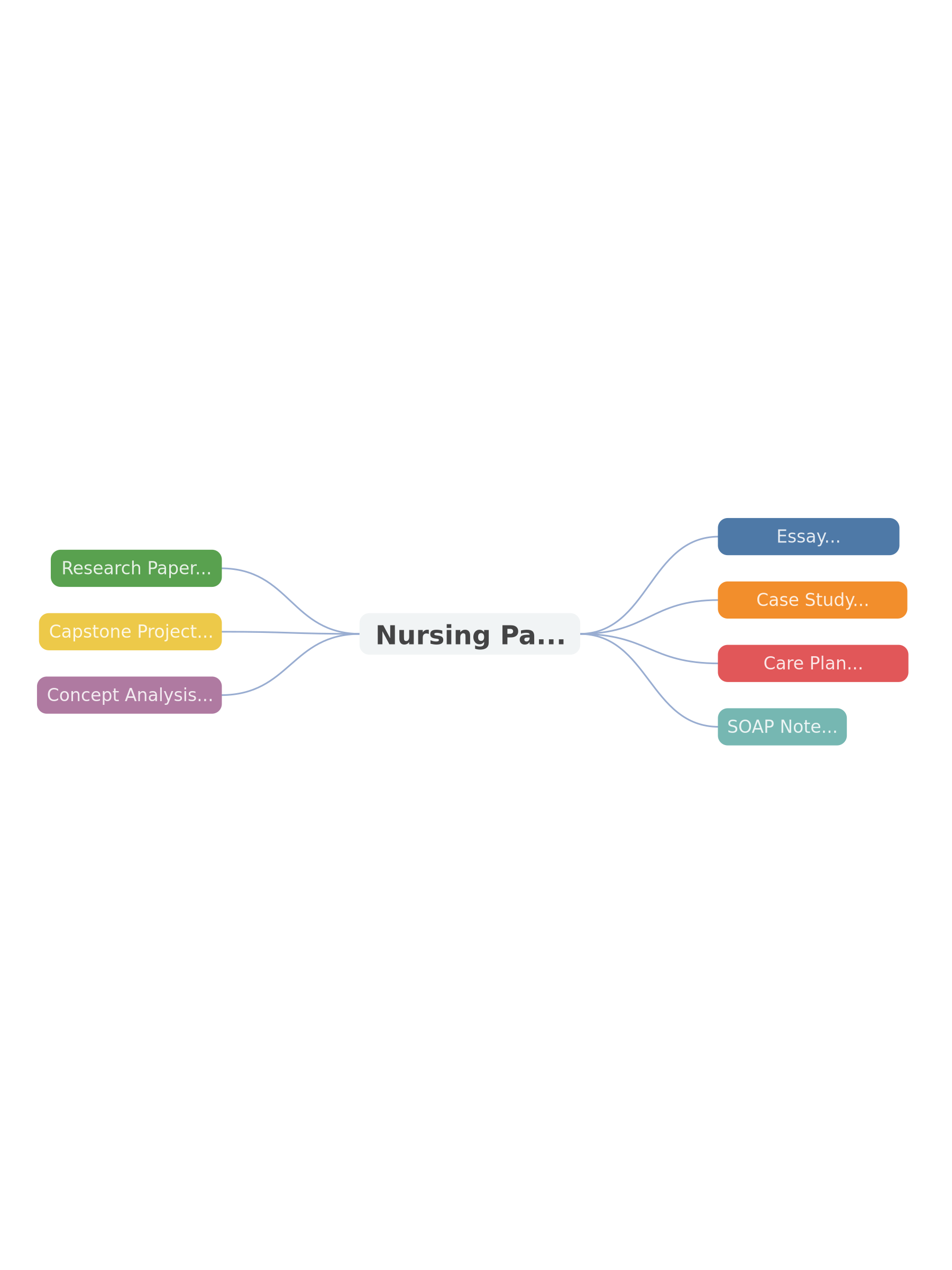
Nursing students encounter seven major paper types — this decision tree helps you match your assignment to the right framework and format.
The decision tree above shows the 7 most common nursing paper types and helps you identify what your assignment likely requires. Each branch includes a brief label of when the paper is typically assigned and which framework it uses.
1. Nursing Essay
When assigned: Most common introductory assignment across all nursing programs. Used to assess clinical reasoning, ethical understanding, and communication skills.
Framework: PEEL paragraphs, standard academic structure (Introduction → Body → Conclusion)
What it looks like: An argumentative or reflective essay on a nursing topic — e.g., “Why evidence-based practice matters,” “Ethical dilemmas in patient care,” or “The role of cultural competence in nursing.”
2. Case Study Analysis
When assigned: Often paired with clinical rotations or simulation labs. Students analyze a patient scenario critically.
Framework: ADPIE — the paper emphasizes clinical reasoning over care plan formatting.
What it looks like: A narrative analysis of a patient scenario. You describe the patient’s situation, apply the ADPIE framework to organize your thinking, and provide a detailed clinical reasoning narrative. See our comprehensive care plan guide for deeper care plan formatting details.
3. Nursing Care Plan
When assigned: The single most common advanced nursing assignment. Required in virtually every BSN and MSN program.
Framework: ADPIE + PES format (Problem → Evidence → Link) + NANDA-I/NIC/NOC
What it looks like: A structured document translating patient assessment data into actionable nursing interventions. Uses standardized NANDA-I diagnostic labels, NIC interventions, and NOC outcomes.
4. SOAP Note
When assigned: Used during clinical rotations, preceptorship, or when advanced practice nursing (NP) programs require clinical documentation training.
Framework: SOAP (Subjective, Objective, Assessment, Plan) + SOAPIE/SOAPIER extensions
What it looks like: A clinical documentation format organizing patient care into four sections. It’s a legal record — write every entry as if it will be read in court. Our SOAP note documentation guide covers this format in detail.
5. Research Paper
When assigned: Required in upper-level BSN, MSN, and DNP programs. Focuses on evidence-based practice (EBP).
Framework: PICOT question format + systematic literature review
What it looks like: A structured investigation of a clinical problem using the best available evidence. Builds on a PICOT question (Population, Intervention, Comparison, Outcome, Time) to guide a systematic literature search. Learn how to build your EBP paper with PICOT.
6. Capstone Paper
When assigned: Final project in BSN, MSN, or DNP programs. Synthesizes everything you’ve learned.
Framework: PICOT + ADPIE + implementation plan
What it looks like: A comprehensive project that translates a clinical problem into an evidence-based implementation plan. Often ties directly to your degree level — BSN = unit-level, MSN = department-wide, DNP = system-wide.
7. Concept Analysis Paper
When assigned: Required in graduate-level (MSN, DNP, PhD) programs. Uses the Walker & Avant framework.
Framework: Walker & Avant 8-step method
What it looks like: An academic exercise defining a nursing concept (e.g., “resilience,” “patient empowerment,” “nursing empathy”) using defined attributes, empirical referents, and case construction. Our concept analysis paper guide walks through the full framework.
The Universal Writing Process (ADPIE + PEEL)
Here’s the secret to writing ANY nursing paper: ADPIE is the thinking framework, PEEL is the writing framework. ADPIE tells you how to process the clinical data. PEEL tells you how to write each paragraph. Together, they cover every nursing paper you’ll ever write.
ADPIE — The Reasoning Framework
The ADPIE framework maps directly to the nursing process:
- A (Assessment): Collect subjective and objective data from the patient or scenario
- D (Diagnosis): Formulate a nursing diagnosis (not a medical diagnosis!) using the PES format
- P (Planning): Set measurable, time-bound outcomes (SMART goals)
- I (Implementation): Select evidence-based interventions with rationales
- E (Evaluation): Assess whether outcomes were met, partially met, or not met
The ADPIE framework applies to care plans, case studies, AND research papers. When a professor says “apply the nursing process” to your paper, they mean ADPIE. As per the NCSBN Clinical Judgment Measurement Model (used in the NextGen NCLEX exam), effective assessment means looking for “cues” that signal a change in a patient’s health status. Cluster related cues together — for example, tachycardia, tachypnea, SpO₂ desaturation, and crackles all cluster around the problem of impaired oxygenation.
PEEL — The Paragraph Framework
PEEL (or TEEL in some UK programs) is the paragraph structure required across virtually all nursing papers:
- P (Point): Your topic sentence — the claim you’re making
- E (Evidence): A citation or data point that supports your claim
- E (Explain): Your explanation of why the evidence matters — connect it to your point
- L (Link): A transition that connects this paragraph to the next one or reinforces your thesis
Here’s an example of a PEEL paragraph in action:
Point: Evidence-based practice (EBP) is the cornerstone of modern nursing, and systematic reviews represent the strongest form of EBP evidence. Evidence: According to the evidence hierarchy (Level 1: systematic reviews/meta-analyses → Level 2: RCTs → Level 3: cohort studies → Level 4: clinical guidelines → Level 5: anecdotal/expert opinion), nursing professors expect students to prioritize Level 1–3 sources. Explain: When you cite a systematic review, you’re citing the synthesis of multiple studies — not just one paper. This gives your argument far more weight than citing a single case study or an anecdotal source. Link: That’s why your literature search should start with CINAHL, PubMed, and the Cochrane Library — databases that host peer-reviewed Level 1–3 evidence.
What we recommend: Use PEEL as your default paragraph structure. If your program mentions TEEL (Topic-Evidence-Explain-Link), that’s a variant — same structure, different label. MEAN (Main idea, Evidence, Explanation, Next idea) is another variant used in some UK programs. They all do the same thing: force you to cite evidence and explain its relevance.
Step-by-Step Guide to Writing a Nursing Paper
Whether you’re writing an essay, a care plan, or a research paper, here’s the universal process:
Step 1: Read the Brief
Start by reading the assignment brief or rubric carefully. Identify the required format, word count, citation style, and grading criteria. Note whether it’s an essay, case study, care plan, or another paper type — this determines which framework you’ll use (PEEL for essays, ADPIE for care plans).
Step 2: Choose Your Topic (If Not Assigned)
If the assignment lets you pick a topic, choose something you’ve observed in clinical practice. Pick a scenario with clear assessment data (vital signs, lab results, patient interview). A topic with measurable data is easier to analyze than an abstract concept.
Step 3: Research Using Peer-Reviewed Sources
Nursing papers require Level 1–3 evidence: systematic reviews, meta-analyses, and RCTs. Start with CINAHL, PubMed, and Cochrane. Avoid anecdotal sources, blogs, or unverified health websites. Every 5 years, your sources must be recent — if a study is from 2021 or earlier, check whether newer evidence exists.
Step 4: Outline Using ADPIE or PEEL
Map your paper structure to ADPIE (for care plans, case studies) or PEEL (for essays, reflective papers). If you’re writing a research paper, outline around the PICOT question: Problem, Population, Intervention, Comparison, Outcome.
Step 5: Draft Using PEEL Paragraphs
Write each paragraph using the PEEL structure. Every paragraph should have a clear claim (Point), supporting evidence (Evidence), your explanation (Explain), and a transition (Link). This prevents “fact dumps” — where you list information without connecting it to your argument.
Step 6: Cite Everything
Use APA 7th edition for every citation — in-text citations and the reference list. Nursing papers are heavily graded for proper citation formatting. A single APA error costs 4 points on a 50-point assignment (Campbellville University’s grading system). Multiple errors can drop a grade from an A to a B or C.
Step 7: Proofread and Check Confidentiality
Review your paper for: proper PES format, correct nursing (not medical) diagnoses, PEEL paragraph consistency, proper APA formatting, and patient confidentiality. Many programs require a confidentiality statement confirming patient anonymization per the NMC Code (2018).
APA 7th Edition Rules for Nursing Papers
APA 7th edition is the standard citation style for nursing papers. But there are nursing-specific adaptations that most students don’t know about. Chamberlain University’s APA guide (2026) explicitly lists four nursing-specific areas:
- Clinical practice guidelines: How to cite APA clinical practice guidelines (they have a different format than journal articles)
- Evidence-based databases: CINAHL, PubMed, and Cochrane are the primary databases nursing students should cite from
- Patient privacy: In-text citations must never include identifiable patient information
- Research terminology: Nursing-specific terminology (nursing diagnoses, NANDA-I labels, NOC outcomes) uses different capitalization and italicization rules
Here’s the Campbellville University grading penalty system — a concrete view of what APA errors cost:
APA 7th Edition Mistakes and Grading Penalties
| Mistake | What It Looks Like | Grading Impact |
|---|---|---|
| Missing hanging indent | References start at the left margin instead of being indented 0.5 inches | 4 points per reference |
| Incorrect italics | Journal names not italicized; volume number italicized (volume should be, issue shouldn’t be) | 4 points per error |
| Wrong in-text citation format | “According to Smith (2023)” instead of “Smith (2023)” — parenthetical vs. narrative confusion | 4 points per instance |
| Missing DOI or URL | Digital articles listed without DOI or URL when available | 4 points per reference |
| Incorrect AND symbols | “AND” used instead of “and” in search strings; “AND” in references instead of “&” | 4 points per error |
| Wrong reference list order | References alphabetized by title instead of by author’s last name | 4 points per reference |
The takeaway: APA errors compound quickly. A single paper with three APA formatting mistakes loses 12 points — potentially dropping a 90/100 to a 78/100. That’s the difference between an A and a B.
Common Mistakes to Avoid
These are the errors that cost nursing students the most points — far more than generic “use current sources” advice:
Mistake 1: Medical Diagnosis vs. Nursing Diagnosis
The problem: Writing “Heart Failure” or “Pneumonia” as your nursing diagnosis. These are medical diagnoses, not nursing diagnoses.
The fix: Nursing diagnoses describe the patient’s response to a health condition. Instead of “Heart Failure,” write “Excess Fluid Volume” related to compromised cardiac output as evidenced by peripheral edema and crackles.
Why it matters: Nursing diagnoses are the focus of nursing interventions. They address the human response, not the pathology. One medical diagnosis can generate three to five nursing diagnoses because patients respond to illness in many different ways.
Mistake 2: Personal Stories Instead of Evidence
The problem: Using anecdotes or personal experiences to support an argument instead of peer-reviewed evidence.
The fix: Use Level 1–3 evidence — systematic reviews, RCTs, and cohort studies. Cite CINAHL or PubMed sources, not blogs or health websites.
Mistake 3: Confidentiality Violations
The problem: Including identifiable patient information (name, age, location, unique identifiers) in your paper.
The fix: Use coded patient identifiers (e.g., “Patient A”) and include a confidentiality statement confirming patient anonymization per the NMC Code (2018).
Mistake 4: Outdated Sources
The problem: Citing sources older than 5 years without explaining why older evidence is still relevant.
The fix: Prioritize sources from the last 5 years. Older sources are acceptable only when describing foundational theories or historical context.
Mistake 5: Ignoring SDOH
The problem: Assessing patients without considering Social Determinants of Health (SDOH) — transportation barriers, food insecurity, caregiver availability, financial constraints.
The fix: Per the 2025 Joint Commission National Patient Safety Goals, every nursing assessment must now include SDOH factors. This affects care planning, discharge readiness, and patient compliance.
What Professors Look For
Every nursing program grades papers against specific criteria. While rubrics vary by institution, the five core dimensions are consistent across virtually all programs:
| Criterion | Description | What Gets Top Marks |
|---|---|---|
| Assessment Quality | Completeness and accuracy of subjective and objective data | Organized data clustered by diagnosis; includes SDOH factors |
| Diagnostic Reasoning | Proper PES format, approved nursing labels, prioritization | Diagnoses linked to specific assessment cues; risk diagnoses use 2-part format correctly |
| Outcome Specificity | SMART goals, clear measurability, patient-centered | Goals use functional language; time-bound with specific metrics |
| Intervention Appropriateness | Evidence-based, specific actions, linked to diagnosis | Major NIC interventions cited; rationale provided for each action |
| Evaluation Accuracy | Met/partially met/not met judgment with supporting data | Data cited to support judgment; adjustments to plan noted |
The single most common mistake: Students list interventions without explaining why they work. Every intervention needs a physiological rationale — not just “Give oxygen,” but “Administer oxygen via nasal cannula at 2–4 L/min to improve alveolar oxygenation and correct hypoxemia caused by impaired gas exchange.”
What we recommend: When writing any nursing paper, start with the ADPIE framework, apply PEEL paragraphs, and always provide evidence-based rationales. This covers the five grading dimensions every professor looks for.
Quick Checklist Before Submission
Run through this list before you hit submit. It catches the most common grading penalties:
- ✅ Diagnosis format: Proper PES format with approved NANDA-I or nursing diagnostic labels — NOT medical diagnoses
- ✅ PEEL paragraphs: Every paragraph has a Point, Evidence, Explain, and Link
- ✅ APA 7th edition: Proper hanging indents, italicization, in-text citations, reference list alphabetization, DOI/URL inclusion
- ✅ Evidence quality: Level 1–3 evidence (systematic reviews, RCTs, cohort studies) from CINAHL, PubMed, or Cochrane
- ✅ Confidentiality: Patient identifiers coded; NMC Code (2018) confidentiality statement included if required
- ✅ SDOH factors: Social Determinants of Health included in assessment (2025 Joint Commission requirement)
- ✅ SMART outcomes: Measurable, time-bound, patient-centered goals
- ✅ Rationales: Every intervention paired with a physiological rationale
- ✅ Word count: Meets or exceeds minimum word count (10% intro, 80% body, 10% conclusion)
Related Guides
For more nursing assignment help, explore these resources from Essays-Panda:
- Nursing Care Plan Guide — NANDA-I, NIC, NOC framework with 5 patient scenarios
- SOAP Note Documentation Guide — Step-by-step clinical documentation for nursing students
- PICOT Question and EBP Paper Guide — How to write an evidence-based practice paper
- Concept Analysis Paper Guide — Walker & Avant 8-step method for graduate-level assignments
- SBAR Communication Tool Guide — Shift report communication for bedside nursing
- APA Citation Style Guide — Complete APA 7th edition formatting rules
Summary
Writing a nursing paper isn’t about memorizing templates. It’s about understanding two universal frameworks — ADPIE for clinical reasoning and PEEL for paragraph structure — and applying them consistently across every paper type.
The key takeaways:
- All nursing papers share the ADPIE framework — Assessment, Diagnosis, Planning, Implementation, Evaluation
- Every paragraph should follow PEEL — Point, Evidence, Explain, Link
- Nursing diagnoses (not medical diagnoses) are the focus of nursing interventions
- APA 7th edition has nursing-specific adaptations that affect your grade
- Confidentiality, SDOH, and evidence quality are the three factors professors grade separately
If you’re struggling with any part of the nursing paper process — writing proper PES diagnoses, selecting evidence-based interventions, formatting APA citations correctly, or anything else — Essays-Panda’s academic writers understand the frameworks that power nursing education. Explore our related guides for deep dives on specific paper types, or visit our order page for personalized support.